How Far in Advance Should Lehigh Valley Homeowners Plan a Deck Build?
Lehigh Valley homeowners should plan a deck build at least 4 to 6 months before the season they want to use it. If you want to enjoy the deck in spring or summer, the least stressful move is to start planning in fall.
That answer surprises a lot of homeowners. They look at the backyard, picture a finished deck, and assume the hard part is the crew showing up and building it. In practice, the build itself is usually the easy part to schedule once the design is settled, approvals are in place, and materials are ready.
A smooth project starts long before the first post hole is dug. In Allentown, Coopersburg, Center Valley, and the surrounding Lehigh Valley, the homeowners who have the best experience are usually the ones who start early, make selections decisively, and treat planning as part of the project, not as a delay.
The Reality of a Lehigh Valley Deck Timeline
If you're asking how far in advance should Lehigh Valley homeowners plan a deck build, the short answer is simple. Plan earlier than your instincts tell you to.
For this area, 4 to 6 months ahead is the practical window, especially if your goal is warm-weather use. Kennedy Design + Build advises homeowners to start the planning phase in fall to secure a place on the spring build schedule, which is the most practical target for a ready-to-use deck when the weather turns according to Kennedy Design + Build's timeline guidance.
Why the timeline feels longer than expected
People tend to think in terms of build days. They don't think about concept work, measurements, revisions, permit submissions, review comments, ordering, delivery coordination, and fitting the job into an active production schedule.
That's why a realistic deck timeline is less about how fast a crew can frame and finish. It's about how many moving parts have to line up before construction starts.
Practical rule: If you want to use your deck in a specific season, plan backward from the first day you want to enjoy it, not from the day you hope construction begins.
What works in the real world
Homeowners usually have a better experience when they handle a few decisions early:
- Use date first: Decide when you want the deck ready, whether that's Memorial Day, midsummer entertaining, or fall football season.
- Scope next: Settle whether this is a straightforward deck or part of a larger outdoor living plan with lighting, a pergola, a fire feature, or adjoining hardscape.
- Team selection early: Choose your builder before peak demand closes up the calendar.
If you're still getting familiar with how a design-build firm approaches that process, the Kennedy Design + Build team gives a clear picture of how projects are managed from concept through construction.
Understanding the Four Phases of a Deck Project
A custom deck doesn't move in one straight line. It moves through four distinct phases, and each one affects the final completion date.
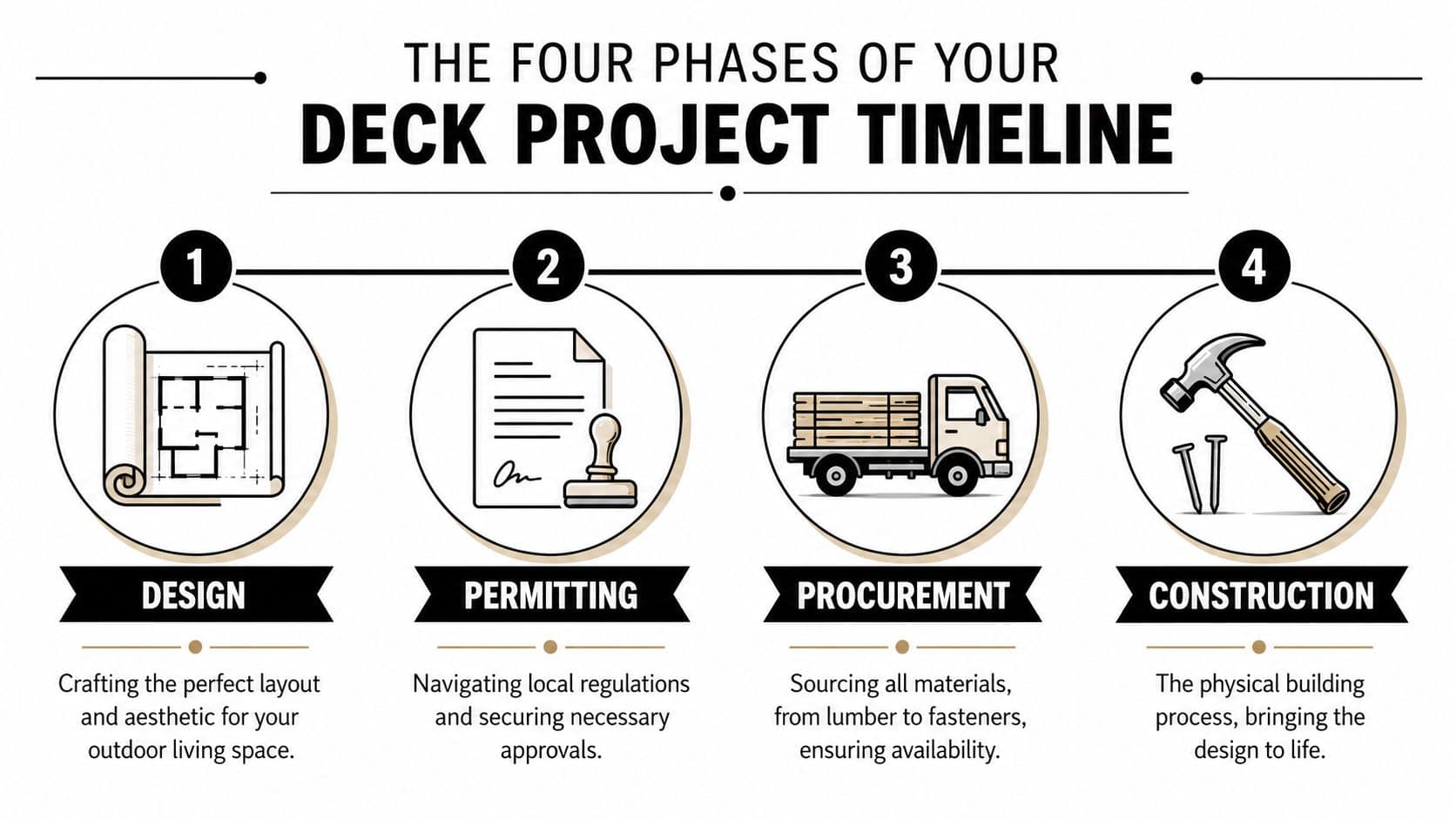
Design
The project either gets easier or harder at this point.
The design phase includes field measurements, layout decisions, stair placement, railing choices, material selections, and the relationship between the deck and the rest of the property. A rushed design usually creates problems later. Homeowners change dimensions after pricing. Stairs conflict with a patio plan. Lighting gets added after the permit set is already in motion.
That kind of rework slows everything down.
Permitting
Permitting is where many homeowners lose track of time. They assume the design is done, so the job is ready to build. It usually isn't.
Municipal approval takes coordination, paperwork, and patience. Some jurisdictions move cleanly. Others ask for revisions, clarifications, or additional details. If the project includes specialty features, the review can become more involved.
The critical path usually isn't framing. It's everything that has to happen before the crew can unload material.
Procurement
Once the scope is approved, materials have to be ordered and scheduled. That sounds simple until selections include specialty railing systems, composite decking colors, lighting components, or custom details that aren't sitting on a shelf locally.
This is also where homeowners often refine the look of the space. Some browse ideas for enclosures, shade, or privacy features to transform your deck into an oasis. That kind of inspiration can be useful, but it's best handled before final purchasing starts.
Construction
Construction is the visible phase, but it usually isn't the longest one. According to Oak City Hardscapes' deck timeline breakdown, on-site construction may take only 1 to 3 weeks, while the full project calendar can stretch to 4 to 10 weeks once design, permits, deliveries, and inspections are part of the schedule. The same source notes that some projects should be planned around 90 days ahead because pre-construction work often drives the timeline.
A simple way to approach this:
| Phase | What actually happens |
|---|---|
| Design | Layout, materials, revisions, scope decisions |
| Permitting | Drawings, submissions, reviews, approvals |
| Procurement | Ordering, confirming, coordinating deliveries |
| Construction | Site work, framing, decking, rails, inspections |
For homeowners comparing delivery models, the Kennedy Design + Build services page shows the kind of projects that often benefit from having design and installation handled together.
A Sample Deck Planning Schedule for a Summer Debut
Let's use a common target. You want the deck ready by Memorial Day.
That goal is possible, but only if the work before construction happens on time. The mistake isn't wanting a late-spring completion. The mistake is starting the conversation when spring is already underway.
Working backward from Memorial Day
A realistic planning schedule looks like this:
| Timeframe | Key Actions |
|---|---|
| Fall | Initial consultation, site review, discussion of size, layout, materials, and how the deck should connect to the house and yard |
| Late fall into winter | Design development, revisions, pricing alignment, final scope decisions |
| Winter | Permit preparation, permit submission, product selections, ordering of primary materials |
| Late winter into early spring | Approval follow-up, scheduling, delivery coordination, any final pre-construction details |
| Spring | Site mobilization and construction |
| Memorial Day target | Final walkthrough and seasonal use |
Where homeowners usually get off track
The first issue is indecision in the design stage. Homeowners often want to keep options open, which is understandable, but that only works up to a point. Once drawings are being prepared and materials are being priced, major changes create a chain reaction.
The second issue is underestimating how the deck relates to the rest of the yard. A deck by itself is one project. A deck that ties into a patio, steps down into a fire feature area, or connects to a pool zone is a broader outdoor plan.
If you know the deck is only one piece of a larger backyard upgrade, plan the whole composition early. That's what keeps one decision from disrupting the next.
A better way to think about the schedule
Instead of asking whether the deck can be built fast, ask whether the project can be made ready fast. That is the core scheduling question.
If you'd like to see how a finished outdoor retreat can come together as one coordinated plan, this Center Valley deck and patio project is a useful example of how the deck fits into the larger living space, not just the structure itself.
Navigating Lehigh Valley Permits and Seasonal Demand
The Lehigh Valley adds two realities that generic deck advice often skips over. First, permit experience varies by municipality. Second, spring calendars fill up well before spring arrives.
Permit timing isn't identical across the region
A homeowner in Allentown may deal with a different review experience than someone in a smaller township outside Center Valley or Coopersburg. The standard isn't that one place is good and another is bad. It's that local process, documentation expectations, and review flow can differ.
That's why experienced planning matters. When drawings are thorough and the scope is clear, the permit process usually moves better. When the design is still shifting after submission, delays tend to follow.
A practical mistake is assuming the permit is just paperwork. It isn't. It is part of the project schedule, and it needs room on the calendar.
Seasonal demand changes everything
Many homeowners start calling deck builders when the weather breaks. By then, a lot of spring and early-summer capacity is already spoken for.
According to Archadeck's guidance on winter deck planning, many contractors advise booking 3 to 5 months in advance for spring or summer work because peak-season scheduling can push even well-defined projects behind earlier reservations. The same guidance notes that if you want the deck finished by Memorial Day, design and permits need to be finalized much earlier than most homeowners expect.
That tracks with what happens in this market. The strongest builders don't sit idle all winter waiting for warm weather. Their spring boards are often filling while homeowners are still deciding whether to move forward.
- Winter planning helps with access to the schedule: You have more room to finalize scope before production is crowded.
- Early approvals reduce pressure: Permit questions are easier to handle when every decision isn't on a compressed spring deadline.
- Selections are cleaner: Material choices tend to go smoother when you're not trying to force every decision into one short window.
If you're weighing deck styles, material choices, and related outdoor features, the patios and decks service page gives a good overview of how those projects are approached in this region.
How Deck Complexity Affects Your Timeline
Not all decks follow the same calendar. Scope changes everything.
A simple platform deck and a feature-rich outdoor living structure may both be called “deck projects,” but they don't move through design, approvals, and procurement at the same speed.
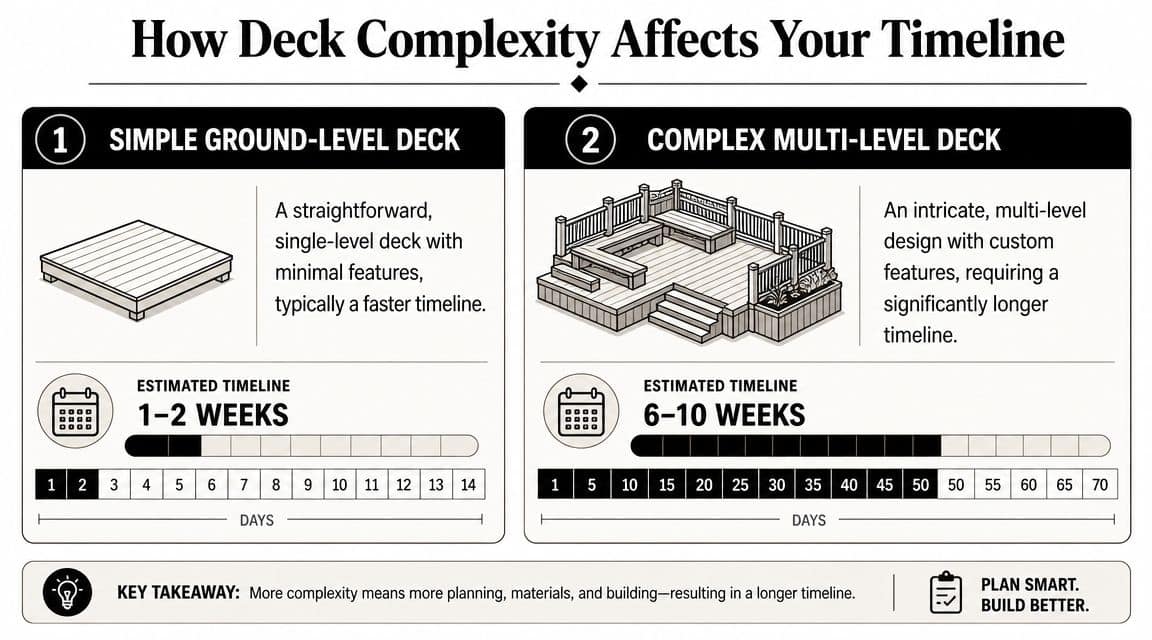
Simple deck versus complex deck
A straightforward project usually has fewer variables. The layout is clean. The selections are limited. The connection to the yard is uncomplicated.
A more advanced build often includes multiple stair runs, custom rails, integrated lighting, a roof structure, a pergola, or transitions into a kitchen or patio zone. Those additions affect every phase. The design takes longer to resolve. The permit package can become more involved. Procurement gets tighter because there are more components to coordinate.
| Project type | Timeline pressure points |
|---|---|
| Simple ground-level deck | Fewer design revisions, fewer specialty selections, cleaner field execution |
| Multi-level custom deck | More detailing, more coordination, higher risk of approval or material bottlenecks |
Complexity also changes budgeting
In the Lehigh Valley, regional renovation data shows deck construction commonly ranging from $15 to $75 per square foot installed, with many custom composite projects falling between $15,000 and $45,000. That same data identifies the category as rising, which is one reason early planning matters for budgeting, revisions, and contractor availability.
For homeowners adding adjacent entertaining features, idea galleries can help clarify what belongs on the deck itself and what should live nearby. Some people find inspiration in Woodstock Furniture deck solutions when thinking through privacy, enclosure, or comfort upgrades.
More features don't just add build time. They add decision time.
If your deck is likely to include cooking, serving, or full entertaining functions, it helps to coordinate that early with related elements like an outdoor kitchen design, rather than treating those items as add-ons after the deck is already designed.
Common Questions About Deck Building Timelines
What causes the most deck project delays
Late decisions cause more trouble than most homeowners expect.
When dimensions change, materials change. When materials change, pricing, drawings, and sometimes approvals change with them. The cleaner the scope is before submission and ordering, the smoother the job usually goes.
Can a deck be built during winter in Pennsylvania
Yes, in many cases it can. Winter planning and winter construction aren't the same thing, but both can be workable depending on site conditions, material choices, and municipal timing.
For many homeowners, winter is less about enjoying active construction and more about getting ahead. It creates room for design work, approvals, and scheduling so the project is ready to move when the season opens up.
I want a deck for this summer. Is it too late
That depends on the scope and on the current calendar. A simpler project may still be possible. A highly customized project with several integrated features is harder to turn around quickly without compromise.
The best next step is to define the scope. If the vision includes shade, lighting, cooking space, or fire features, plan the whole outdoor setup together. If you're considering a fire element near or on the deck, this Van Dyke Outdoors fire pit guide is a useful starting point for thinking through placement and safety considerations before design gets locked in.
Should I plan the deck separately from the rest of the backyard
Only if it stands alone.
If the deck is going to connect to patios, plantings, a pool area, a pavilion, or entertaining zones, treating it as an isolated structure often creates expensive redesign later. One coordinated plan almost always works better than stitching together separate projects over time.
If you're planning a deck in Center Valley, Allentown, Coopersburg, or anywhere in the Lehigh Valley, Kennedy Outdoor Living can help you sort out the scope, timing, and design decisions before the schedule gets tight. The earlier the planning starts, the more options you keep open, and the smoother the project tends to run.