Retaining Wall Installation: A Lehigh Valley Guide
If you're looking at a sloped yard, water washing out mulch, or a patio project that needs a grade change, a retaining wall often looks simple from the surface. It isn't. What reads as a row of block or stone is really a structural system that has to resist soil pressure, move water, and stay stable through freeze-thaw cycles and changing site conditions.
In the Lehigh Valley, that matters because retaining walls are rarely standalone features on high-end properties. They usually tie into patios, steps, pool areas, planting beds, driveways, or outdoor kitchens. Once a wall becomes part of a larger outdoor living plan, the decisions behind it carry more weight. A wall that looks good on install day but shifts, cracks, or bulges later can compromise everything connected to it.
Good retaining wall installation comes down to judgment. Material matters. Drainage matters more. Layout matters. Engineering matters when loads increase. The right approach depends on what the wall is doing, what sits above it, and how the site handles water.
Initial Planning and Site Assessment
Most retaining wall problems start before excavation. They start with the wrong assumption. Homeowners often think the question is, "What block should we use?" The essential question is, "What is this wall being asked to do?"

A wall that holds a small grade transition in a planting bed is one thing. A wall that supports a patio edge, creates level lawn space, or retains soil near a driveway is a different category entirely. On integrated projects, that distinction shapes the layout, the excavation plan, the drainage strategy, and whether an engineer needs to be involved.
Start with function, not appearance
Before choosing finishes, define the wall's job:
- Grade retention: Is the wall holding back a slope that already exists?
- Space creation: Are you cutting into a hill to make room for a patio, pool, or lawn?
- Edge definition: Is the wall mostly visual, with limited retained soil?
- Load support: Will there be pavement, structures, or vehicle traffic near the top?
Those are not cosmetic differences. They change the structural demands of the wall.
A good site review also looks at water first. Where does runoff come from. Where does it go. Does the yard stay wet after storms. Is there a downspout discharging near the proposed wall. You can build a beautiful wall on a bad water path and still end up with movement.
Practical rule: If the site already shows signs of erosion, pooling, or soft ground, treat drainage as a primary design issue, not a cleanup item at the end.
Read the slope the way a builder does
Slope severity matters, but so does what happens above and below the wall. A steep bank with open lawn above it behaves differently than a bank supporting a future terrace. The same is true for access. If equipment can't reach the area cleanly, excavation and base prep become slower and more complicated.
This is also the point where wall height changes the conversation. A widely cited threshold in North American practice is that retaining walls over 4 feet tall generally require a permit in many jurisdictions, and they may also trigger soils investigations or engineered drawings, as noted in this retaining wall permitting overview. That threshold matters because the 4-foot mark often changes the entire project workflow.
For homeowners, the takeaway is simple. Once a wall gets taller, or once the site gets more complex, it stops being a basic hardscape detail and starts acting like a structural element.
Questions worth answering early
A solid planning conversation usually includes:
What sits above the wall now
Existing lawn, planting bed, driveway, or nothing yet all lead to different design decisions.What might sit above it later
Future patios, fire features, and stairs change how we think about reinforcement even if they aren't being installed today.How will the wall connect to the rest of the project
On an integrated build, transitions matter as much as the wall itself. A full-property view helps, especially on projects like this Breinigsville exterior makeover, where grading, hardscape, and visual flow have to work together.What is the property telling you already
Leaning fences, washed-out mulch, exposed roots, and damp low spots are all clues.
A retaining wall succeeds when the plan respects the site instead of forcing a standard detail onto it.
Choosing Your Retaining Wall Materials
Material selection isn't just about taste. It's about matching the wall system to the architecture, the site conditions, and the level of structural demand. Some materials are forgiving. Some are beautiful but labor-intensive. Some make sense for a short garden wall and become a poor choice when the wall has to carry real load.
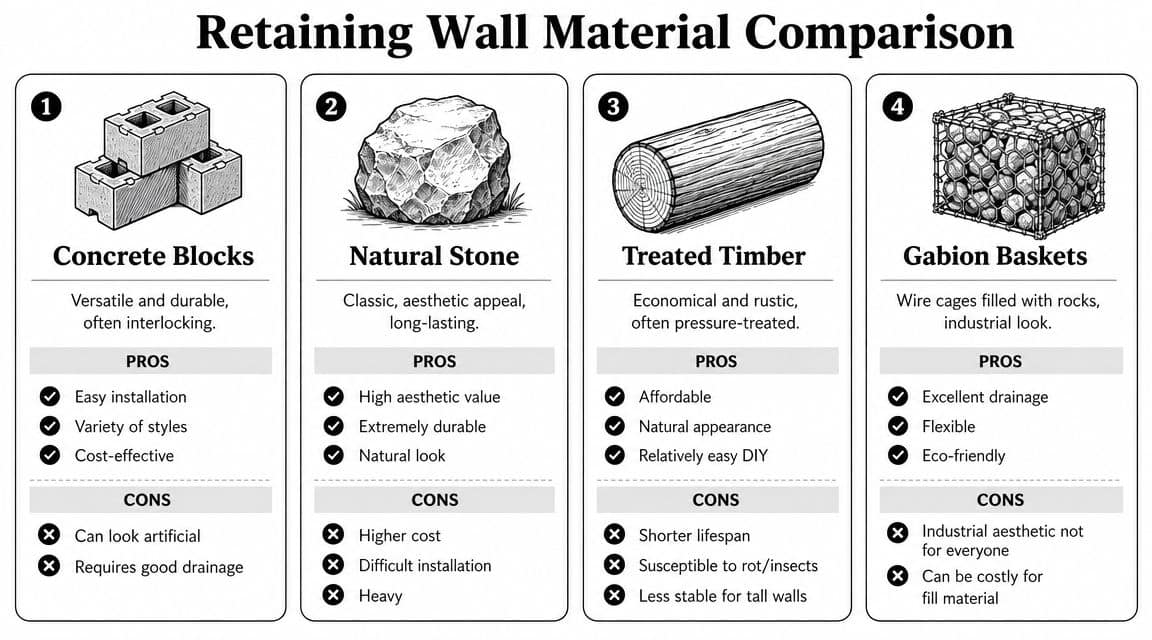
How the common options compare
| Material | Where it fits well | What to watch for |
|---|---|---|
| Segmental concrete block | Versatile walls, curves, terraces, integrated hardscape projects | Needs proper base, drainage, and reinforcement to perform well |
| Natural stone | Traditional homes, estate properties, rustic or timeless settings | Installation is slower, layout takes skill, and stone choice affects consistency |
| Poured concrete or structural concrete core with finish | Clean-lined modern work, walls with a sharper architectural look | Forming, finish quality, and crack control require experience |
| Timber | Limited decorative use in the right rustic setting | Shorter service life and weaker long-term fit for demanding retaining applications |
| Gabion systems | Select contemporary or utilitarian projects with a specific design language | Not every home benefits from the look, and fill selection matters |
Segmental block for most integrated outdoor projects
For many residential retaining wall installation projects, segmental retaining wall block is the most practical choice. The systems are engineered, consistent in size, and adaptable to straight runs, curves, steps, and elevation changes. They also fit naturally with pavers, coping, and outdoor living features.
That doesn't mean every block wall is equal. Some look overly manufactured in the wrong setting. Others have better texture, color range, and face detail that work well on upper-end homes. When the wall is visible from a patio or pool area every day, those details matter.
On properties where the wall ties into entertainment space, block systems also make it easier to coordinate textures and tones with broader patio and deck design considerations.
Natural stone for character and permanence
Natural stone has a look manufactured materials still can't fully duplicate. On farmhouse properties, older homes, and outdoor spaces where the goal is a settled, regional feel, stone can be the right answer. It tends to age well visually because variation is part of the appeal.
The trade-off is precision and labor. Stone walls ask more of the installer. The crew has to read each piece, manage bearing surfaces, and keep the face natural without sacrificing stability. A stone wall that looks casual usually took careful work to make it look that way.
A material can be beautiful and still be wrong for the wall. The site decides first. The finish comes second.
Concrete, timber, and gabion systems
Poured concrete can make sense when the architecture is modern and crisp lines are part of the design language. It can also work when a wall will receive another finish treatment. The downside is that concrete is unforgiving. Form lines, surface variation, and visible cracking stand out quickly if the execution is average.
Timber still shows up in residential outdoor areas, usually because it's familiar or seems simpler. For a temporary or lightly loaded garden situation, it may have a place. For a long-term, high-value exterior feature, especially one tied to major hardscape, it usually isn't the material I'd want a client investing in.
Gabion baskets have a distinct look and strong drainage characteristics. They can work on select properties, especially where a more contemporary or industrial expression fits. They are not a universal answer, and on many Lehigh Valley homes they feel visually disconnected from the architecture.
The right material choice is the one that fits the house, performs on the site, and still makes sense after years of weather and use.
The Anatomy of a Structurally Sound Wall
A retaining wall should be judged from the ground below and the soil behind it, not just from the face you see. The visible portion is only one layer of the system. If the hidden components are weak, the wall's appearance won't save it.
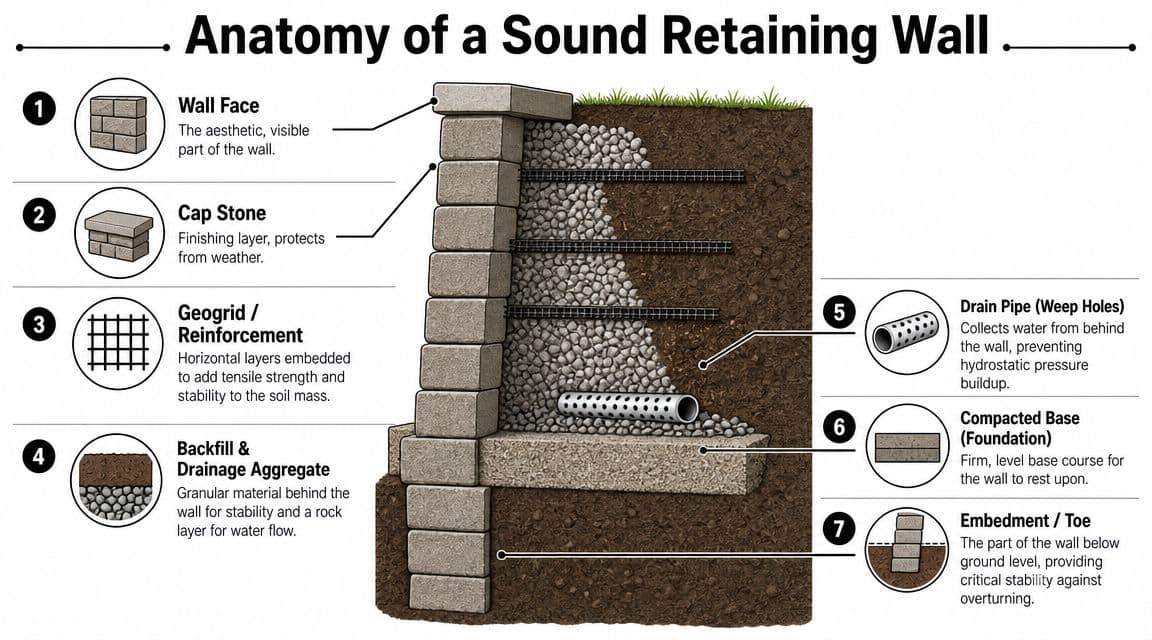
The base has to be level and compacted
A sound wall starts with excavation and base preparation. Industry guidance consistently calls for a compacted, level trench because the base is carrying the whole system. Nitterhouse recommends a trench about 8 inches deep, slightly wider than the blocks, then 4 inches of gravel tamped level, while Mutual Materials gives a benchmark of a trench minimum of 6 inches deep plus 1 inch for every foot of wall height, with 6 to 8 inches of space behind the wall for drainage stone and a minimum trench width of about 12 inches, as summarized in this retaining wall installation guide.
The practical lesson is more important than the measurements. If the first course is off, every course above it gets worse. Small errors become visible alignment problems, then structural ones. That is how you end up with caps that won't line up, a face that waves, or a wall that starts to rotate outward.
Drainage prevents pressure from building behind the wall
Most failures people blame on "settling" are really water problems. Water trapped behind a wall adds pressure where you don't want it. Good retaining wall installation is built around moving that water out.
Keystone specifies 1/2 to 3/4 inch crushed stone drainage material extending a minimum total distance of 24 inches behind the wall face, with backfill placed in maximum 8-inch lifts and compacted to 95% Standard Proctor Density or 92% Modified Proctor Density in its installation manual for wall construction. Unilock likewise recommends free-draining gravel and a drainage pipe to carry excess water away.
That tells you what current best practice looks like. This isn't just about stacking block. It's about controlling hydrostatic pressure and building a stable soil mass behind the wall.
Field note: A dry-looking yard can still hold water where the wall sits. Surface appearance doesn't tell you what the backfill zone will do after repeated storms.
Reinforcement, embedment, and the parts clients rarely see
The strongest walls include details many homeowners never notice:
- Embedment at the base: Part of the wall is buried to resist sliding and overturning.
- Drainage aggregate behind the face: This creates a path for water to move instead of build pressure.
- Perforated pipe: Used where the design calls for collecting and redirecting water.
- Geogrid reinforcement: This ties the wall back into the retained soil, turning the system into more than a stacked face.
- Proper compaction in lifts: Dumping all the fill in at once doesn't produce the same result.
Corners and caps also need the right hardware and attachment methods where the wall system requires them. On projects that involve concrete connections or anchored accessories, crews often look for application-specific hardware, and resources like XTREME EDEALS INC. for reliable concrete fasteners can help clarify product options.
When you look at completed work, don't just ask whether the wall looks straight. Ask what sits behind it. On a project where the wall ties into a full backyard layout, like this Center Valley deck and patio retreat, the hidden structure is what protects the visible investment.
Navigating Permits Engineering and Surcharge Loads
A lot of failed walls were built by people who thought the visible height was the only thing that mattered. It isn't. Risk often comes from what the wall is supporting and what loads sit near the top.
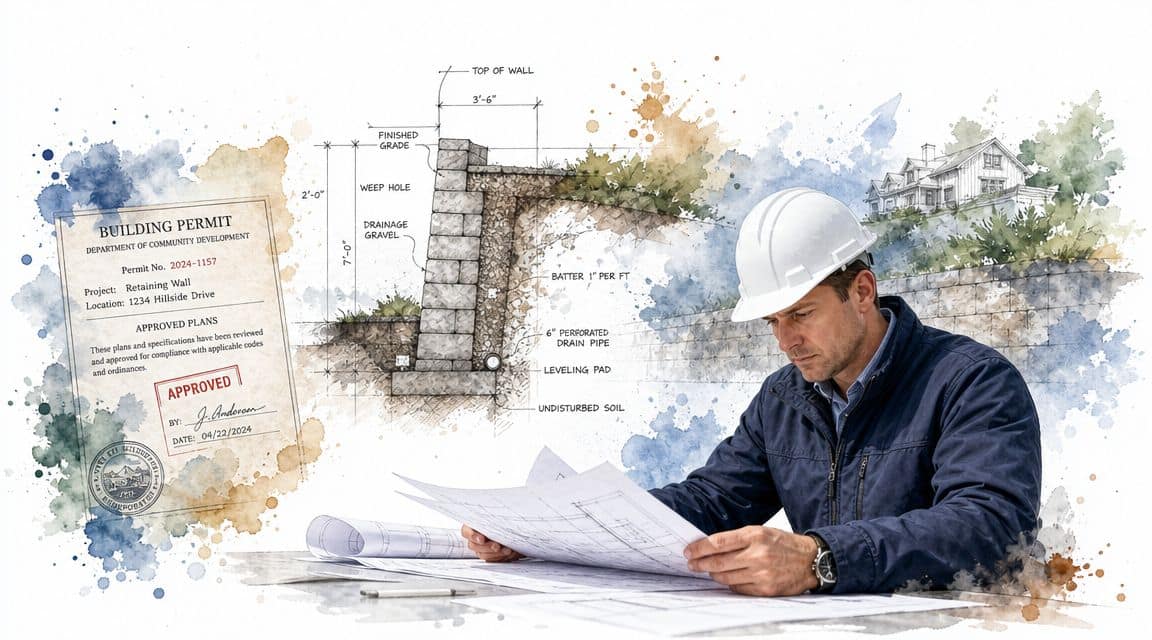
Why simple height rules don't tell the whole story
A common mistake is assuming a wall under the permit threshold is automatically simple. In real projects, surcharge loads change everything. A patio, driveway, stair landing, outdoor kitchen, or even a steep slope behind the wall adds force to the retained soil mass.
Industry guidance consistently notes that embedment, drainage, and reinforcement need to increase as height, slope, and surcharge increase. One training source specifically notes that the minimum 6-inch embedment can increase depending on wall height, slope beyond the wall, and surcharge at the top. It also makes the larger point that a wall can be technically installed and still fail if extra loads were never properly accounted for in the geogrid design, as discussed in this retaining wall design training resource.
That's the line homeowners need to understand. A decorative garden wall and an engineered retaining structure may look similar when finished. They are not the same thing.
When engineering is the smart decision
Engineering isn't red tape. It's risk control.
Bring an engineer into the process when you have conditions like these:
- A patio or driveway above the wall: Hard surfaces create added load close to the face.
- A steep slope behind the wall: The retained soil mass behaves differently than a flat backfill area.
- Multiple wall tiers or grade transitions: One wall can affect another.
- Stairs, columns, or structures tied into the wall: These create concentrated load points.
- Questionable soil or drainage conditions: Soft soils and chronic wet areas deserve a closer look.
Excavation quality matters here too. If you're trying to understand site prep expectations before construction starts, practical references on local residential excavation services can help homeowners ask better questions about access, grading, and foundation work.
What a professional process looks like
For more involved projects, the retaining wall design should be coordinated with the rest of the build. That includes grading, drainage paths, finished elevations, adjacent hardscape, and permit requirements. Some homeowners want a single point of responsibility for that coordination. Kennedy Outdoor Living is one example of a design-build firm that handles design and installation planning across outdoor living projects, including permitting coordination where required through its broader service offerings.
The point isn't who you hire. The point is that someone needs to own the full picture. If the wall, patio, drainage, and elevations are being decided in pieces, that's where expensive gaps show up.
Estimating Project Costs and Timelines
Retaining wall budgets drift when people price the face of the wall and ignore everything behind it. The block or stone is only one part of the cost. Excavation, export or movement of soil, base prep, drainage stone, reinforcement, engineering, access limitations, and finish integration often have just as much influence on the final number.
What usually drives cost
Material choice is the obvious variable, but it isn't the only one. Natural stone generally requires more hand labor and more installation judgment than an engineered block system. A wall in an open yard is simpler than one tucked behind a house with limited machine access. A wall tied into steps, lighting, coping, or patio edges will also require more detail work than a straight run in a side yard.
Soft costs are easy to miss during early budgeting. Permit applications, engineering plans, and site-specific design work aren't optional on many substantial walls. They're part of building the project correctly.
Don't compare retaining wall proposals by face area alone. Two walls that look similar from the front can involve very different excavation depth, drainage detail, reinforcement, and permitting requirements.
What affects schedule
Weather matters, especially when excavation and compaction are involved. Wet conditions slow grading, make subgrade work less reliable, and can interrupt inspections. Material lead times also shape the schedule, particularly if the project uses a specific wall system, cap, or finish material.
A realistic timeline should account for:
- Design and approvals: Layout, finished elevations, and any required engineering
- Permit review: If the municipality requires it
- Excavation and base prep: Often the phase where site surprises show up
- Wall installation and backfill: Which may need to coordinate with other trades
- Final integration: Patios, steps, lighting, planting, and drainage finish work
The more the wall is connected to a larger outdoor living plan, the more important sequencing becomes. That isn't a bad thing. It just means the project should be scheduled as a system, not as a standalone wall crew showing up for a few days.
Choosing a Retaining Wall Installer in the Lehigh Valley
The right installer doesn't just know how to place block. They know how to read a site, when to involve engineering, how to manage water, and how to detail the places most crews rush through. That's where the long-term difference shows up.
What to ask before you hire
Ask direct questions and listen for specific answers.
How do you handle drainage behind the wall
If the answer stays vague, keep asking.When do you bring in engineering
A good contractor won't treat every wall the same.How do you approach corners, curves, and transitions
That's where experience shows up fast.Who manages permits and layout coordination
On larger projects, this matters as much as the install itself.Can you explain how this wall connects to the surrounding patio, steps, or grade changes
The answer should sound integrated, not pieced together.
What a portfolio should show
Pretty photos aren't enough. Look for straight courses, clean cap alignment, smooth transitions, and walls that feel proportionate to the house and surroundings. If the contractor shows only short straight walls, that tells you something. Real-world projects involve corners, elevation changes, and awkward conditions.
Corner work is a useful filter because it's one of the most overlooked details in residential retaining wall installation. A key sign of a true professional is how they handle corners and junctions. Better technical guidance points to alternating running-bond corner placement, use of corner units on the base course, and reducing unnecessary cuts to preserve long-term strength, as discussed in this guide to secure retaining wall corners. Corner failure often shows up later as cracking, separation, or differential movement.
If a contractor can't explain how they build corners, they probably shouldn't be building a complex retaining wall.
Look for a partner, not just an installer
For straightforward walls, a competent installer may be enough. For projects tied to patios, pools, lighting, steps, and grading, a design-build mindset is more useful. The wall has to make structural sense and also belong to the overall property.
That means looking at how a firm thinks, not just what it builds. A company that approaches the work as part of a complete outdoor environment will usually ask better questions at the start. If you want to understand that kind of background and project philosophy, review the firm itself, not just the gallery. For example, you can learn more through the Kennedy Design + Build team background.
A retaining wall is one of those features where hidden decisions determine whether the visible result lasts. Hire accordingly.
If you're planning a retaining wall as part of a larger outdoor project in the Lehigh Valley, Kennedy Outdoor Living can help you think through the design, grading, structural needs, and how the wall fits into the property as a whole.