How to Hire an Outdoor Living Contractor
A lot of homeowners start in the same place. You save photos of a clean bluestone patio, a pool with room to lounge, a pergola that solves the late-afternoon sun, maybe an outdoor kitchen that finally gets everyone outside. The vision comes together quickly. The hard part is deciding who should turn that vision into a finished space on your property.
The significance of that choice is often underestimated. An outdoor living project isn't just a purchase. It's a sequence of design decisions, engineering decisions, permit decisions, drainage decisions, and material decisions that all have to work together. If the contractor treats it like a simple install, you can end up with a backyard that looks good in photos and creates problems after the first hard rain or winter freeze.
Homeowners are right to take these projects seriously. The U.S. Deck & Patio Construction industry reached an estimated $1.3 billion in revenue in 2026, showing that homeowners continue to invest heavily in upgrading existing outdoor spaces, not just building for new homes, according to IBISWorld's deck and patio construction industry data. That lines up with what we see across the Lehigh Valley. People want outdoor spaces that feel like part of the home, not an afterthought.
Your Guide to Finding the Right Outdoor Living Partner
A good outdoor project usually starts with a simple sentence from the homeowner. “We want to use the backyard more.” Sometimes that means a patio with a fire feature. Sometimes it means a full poolscape, outdoor kitchen, shade structure, lighting, and planting plan tied together as one environment. The project may look different from family to family, but the first real decision is the same. You're not hiring someone to lay stone. You're choosing a partner to guide a complex improvement on your property.
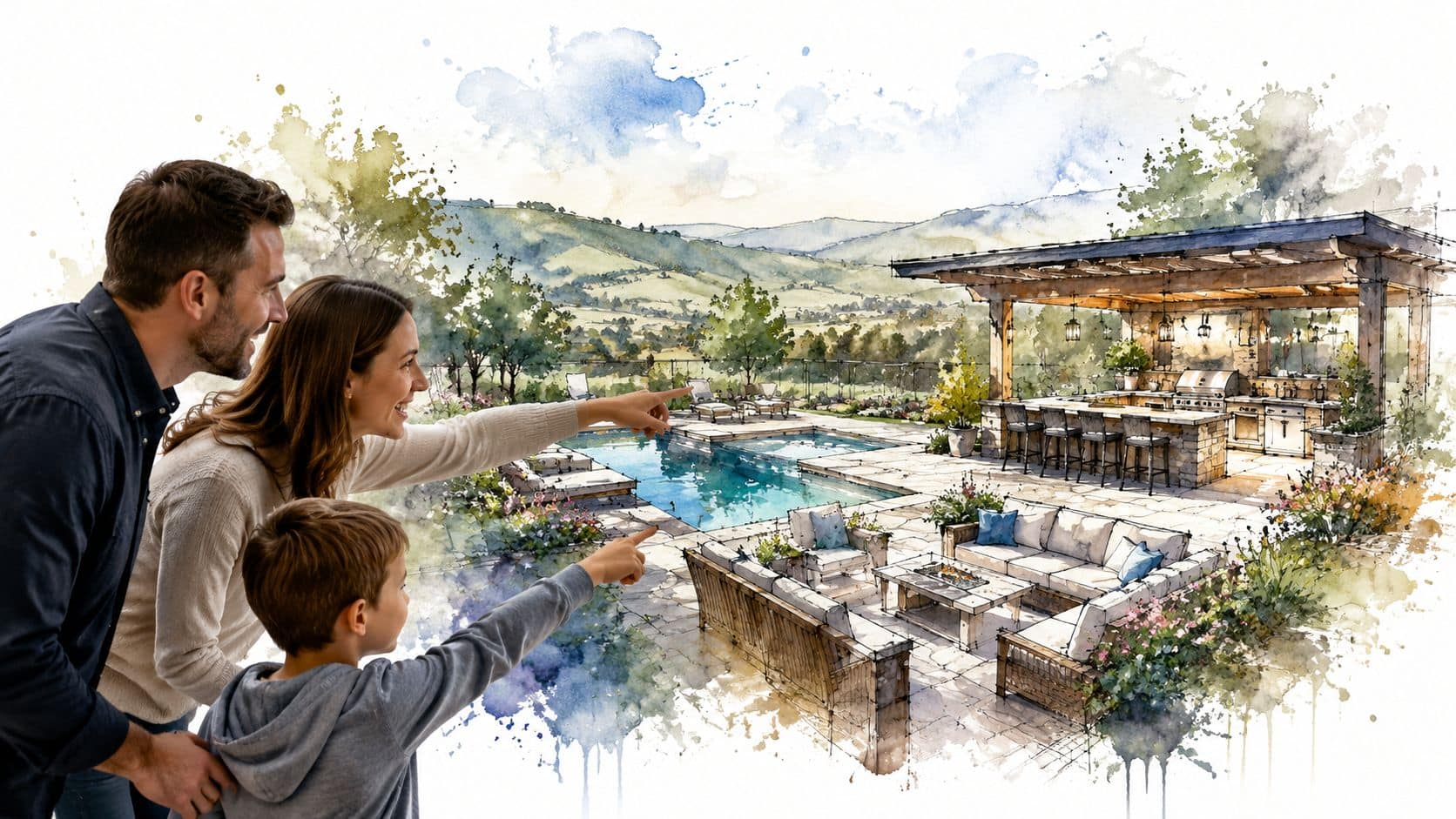
In high-end residential work, homeowners often underestimate how many moving parts have to be coordinated early. Patio elevation affects drainage. The location of a pavilion affects circulation and views. Utilities can affect where a kitchen or pool equipment area can go. Local requirements can affect retaining walls, setbacks, and structures. A contractor who can only talk about finishes is usually not ready to manage the whole job.
What the right partner actually does
The right outdoor living contractor helps you move from a loose wish list to a buildable plan. That means asking better questions than “what color paver do you like?” It means learning how you live, how you entertain, where water moves on the site, and what needs to be solved before construction starts.
If you're still in the idea-gathering phase, it can help to read outside the hardscape world too. A resource on planning your Florida room addition is useful because it shows the same larger principle. Good home additions succeed when the layout, structure, permitting, and intended use are thought through early.
Practical rule: Hire for process first, style second. Style can be designed. A weak process usually stays weak all the way to the end of the project.
For homeowners in this area, that usually means looking for a firm that handles design and installation as one coordinated effort, not as disconnected handoffs. If you want a sense of what that scope can include, Kennedy Design + Build's outdoor living services show the range of elements that often need to be integrated into one plan.
Defining Your Vision and Realistic Budget
Before you interview contractors, do a little homework of your own. Not busywork. Useful homework. The clearer you are about how the space needs to function, the easier it is to recognize whether a contractor is listening or just trying to sell you a package.

Start with use, not with materials
Most homeowners begin with inspiration photos. That's fine, but photos alone won't define the project correctly. A better starting point is how you want the space to work on an average week.
Ask yourself:
- Who will use it most often. A couple who wants a quiet evening patio needs something different from a family hosting large gatherings.
- What activities matter. Dining, swimming, lounging, cooking, watching kids play, and sitting around a fire all pull the layout in different directions.
- What problem needs solving. Shade, privacy, drainage, awkward grade changes, poor circulation, or lack of lighting are design problems, not accessory problems.
- How much of the year you want to use it. In the Lehigh Valley, that affects decisions around wind exposure, covered areas, heating, lighting, and material selection.
A helpful outside resource is your dream backyard design guide, because it pushes the conversation beyond style and into how people inhabit outdoor rooms.
Build a scope before you chase a price
One of the most common mistakes is asking for a “ballpark” before the scope is even defined. That usually produces a number that's too vague to trust or too low to survive real design and site conditions. Square-foot pricing can be useful in narrow contexts, but it's a poor first filter for custom outdoor living.
A patio by itself is one thing. A patio with retaining, low-voltage lighting, drainage work, seat walls, kitchen utilities, and a pergola is another. Same surface area, completely different project.
Here's a better way to frame your budget conversation:
| Question | Why it matters |
|---|---|
| What are the must-haves? | Keeps the core project intact if costs shift during design |
| What are the nice-to-haves? | Creates room for alternates without derailing the plan |
| What site issues already exist? | Drainage, slope, and access often shape cost more than finishes |
| What level of finish do you expect? | Material quality and detailing change the build, not just the look |
A rough estimate can tell you whether a project direction is realistic. A detailed proposal should tell you exactly what is and isn't included.
That's why I usually tell homeowners to define the project in layers. First the purpose. Then the spaces. Then the materials and features. If you're evaluating patios or decks as part of that process, this overview of patio and deck project types is a useful way to think about how different outdoor rooms can fit together.
Know the difference between budget honesty and budget rigidity
You don't need to walk into a meeting with a perfect number. You do need to be honest about your comfort range. A contractor can only guide you well if they know whether you're trying to create a focused first phase or a full-property transformation.
That honesty saves time. It also leads to better design decisions. Sometimes the right move is building a smaller project properly now, with utilities, grading, and layout planned so future additions can happen cleanly later.
Evaluating Craftsmanship Beyond the Photos
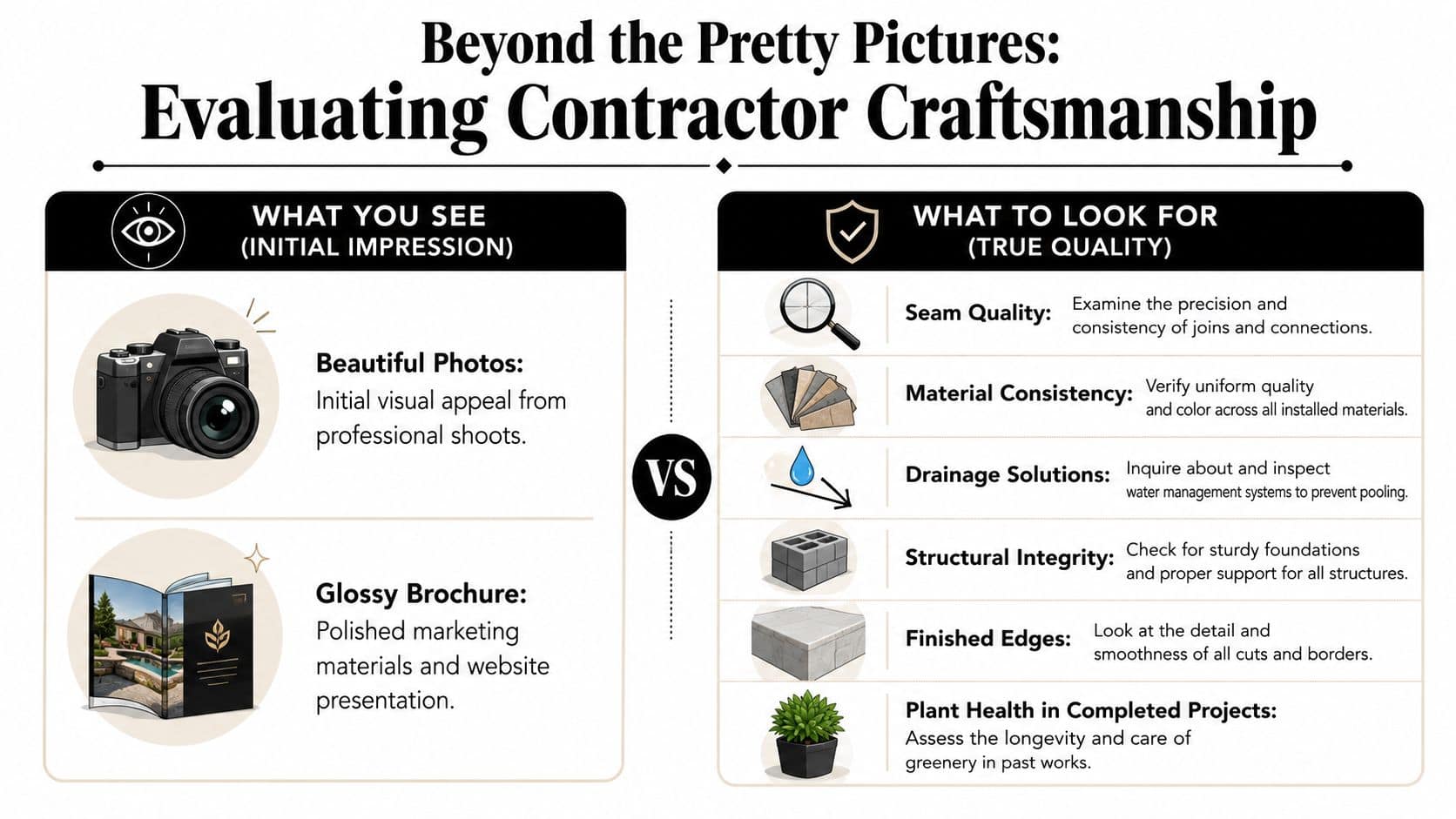
Every outdoor living contractor has finished-project photos. Some are excellent. Some are carefully framed to hide the parts that matter most. Homeowners often focus on stone color, furniture styling, and the glow of evening photography. Those details influence first impressions, but they don't tell you whether the project will hold up.
What a portfolio should prove
A strong portfolio should show more than taste. It should show control. Look closely at transitions where one material meets another. Look at how steps terminate into a patio. Look at whether edges are clean and intentional or improvised. Look at whether walls, columns, kitchen components, lighting, and planting feel coordinated instead of added on one at a time.
If the contractor has progress photos, that's even better. They tell you how the crew handles excavation, base prep, drainage, walls, and utility coordination before the finished surface goes down.
Here are details worth checking when you review completed work:
- Joint and line consistency. Paver fields should look planned, not forced into place with awkward cuts.
- Grade transitions. Stairs, thresholds, and landings should feel comfortable and visually settled into the site.
- Material transitions. Deck-to-patio, patio-to-pool coping, and kitchen-to-walkway connections should look resolved, not accidental.
- Edge restraint and borders. Finished edges often reveal whether the installer thinks structurally or only cosmetically.
- Integration of features. Fire elements, lighting, planting, drainage, and shade structures should read as one project.
The hidden work is the real work
For hardscape-heavy projects, drainage and base preparation decide whether the project ages well. One industry source notes that proper water management prevents 90% of common patio failures, which is why runoff control and stable base construction matter more than surface appearance alone, as explained in Unilock's article on common outdoor living problems.
That point deserves to be translated into plain language. If water is not moved deliberately, it will find its own path. It will undermine pavers, saturate base material, wash out joints, create ice problems, stain surfaces, and push against walls over time. A beautiful patio built on weak preparation is a short-term success.
Ask to hear the drainage plan in ordinary language. If the contractor can't explain where water goes before construction starts, that's a warning sign.
Questions that reveal real craftsmanship
Instead of asking only “what paver brand do you use,” ask things like these:
| Better question | What you learn |
|---|---|
| How do you determine slope across the patio? | Whether the contractor plans drainage instead of guessing |
| What does your base assembly look like on this type of site? | How they think about long-term stability |
| How do you handle wet areas or runoff near structures? | Whether they can protect the home and adjacent spaces |
| Can you show projects after weather exposure? | Whether the work still looks right after use and seasons |
A project page can sometimes help you see whether a contractor understands complete environments rather than isolated features. For example, this Center Valley deck and patio project shows the kind of integration homeowners should look for when evaluating layout, circulation, and finish continuity.
The key is simple. Don't let photography do all the convincing. The quality you'll live with is mostly in the layers that don't show up in the glamour shot.
Essential Questions for Your Contractor Interviews
Once you have a shortlist, the conversation changes. At that point, your goal isn't to be impressed. It's to find out how the contractor thinks, how they communicate, and how they handle complexity when the site doesn't cooperate.
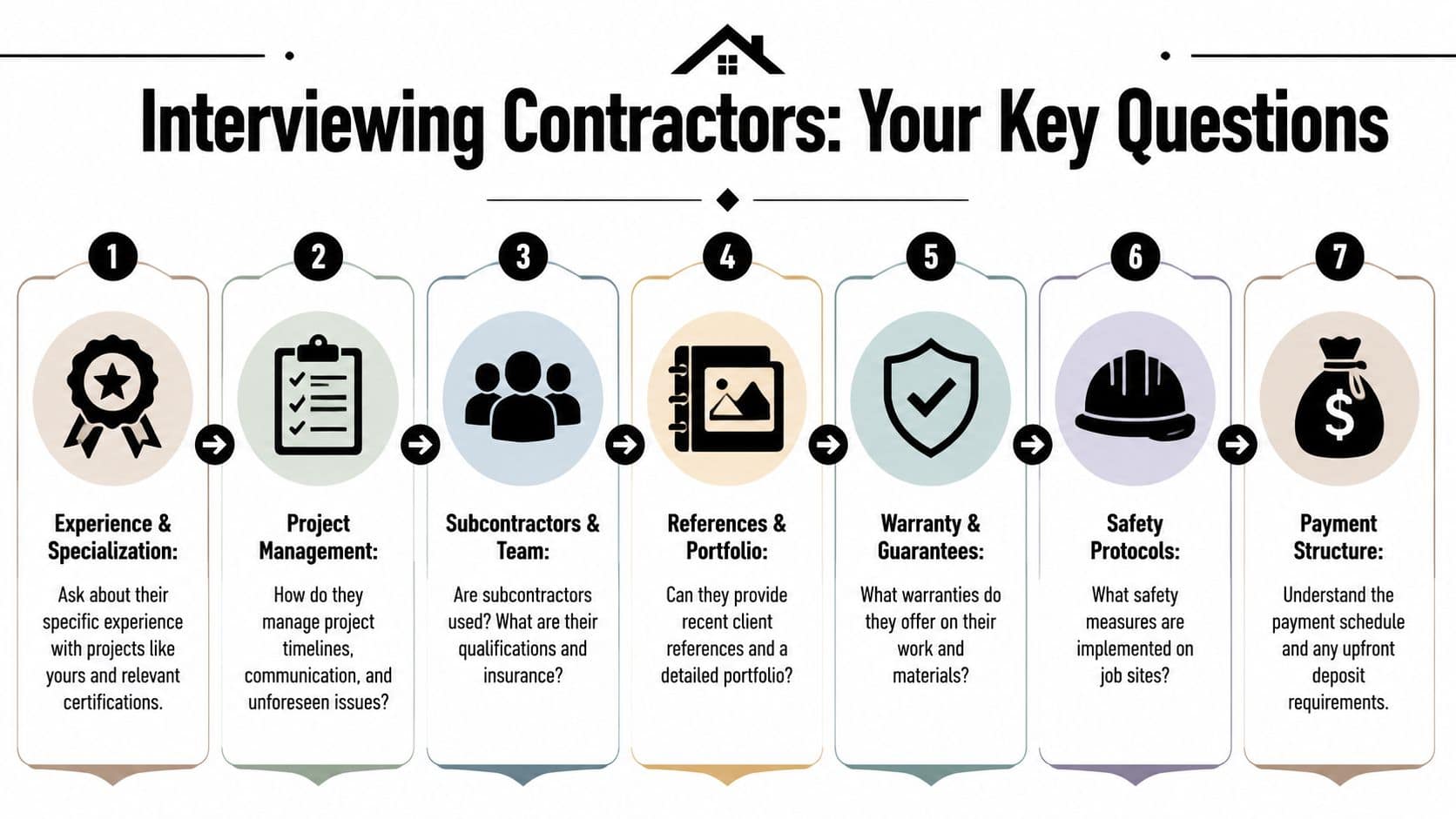
A professional outdoor living contractor should follow a clear staged process that includes site analysis, concept review, detailed scope with material specifications, permit coordination, and final installation, and the clarity of that process matters as much as price, according to Miller Outdoors' guidance on choosing the right contractor.
Listen for sequence, not slogans
The best interviews usually feel calm and specific. The contractor can explain what happens first, what depends on site conditions, when materials are selected, how revisions are handled, and what the homeowner should expect during construction.
If the answers are vague, or if every answer quickly returns to “we can do anything,” that's not reassuring. It usually means the process hasn't been thought through.
Ask these questions and pay close attention to how they answer:
Walk me through your process from first meeting to closeout.
You want sequence. Site visit, design development, specifications, permits, scheduling, construction, punch list, final handoff.How do you evaluate site conditions before finalizing the design?
This reveals whether they study drainage, grade, access, structures, and utility constraints early.What drawings or written documentation will I receive before construction starts?
A serious contractor should define scope clearly enough that you know what is being built.Who is my main point of contact during design and during construction?
Communication problems often start when ownership is unclear.How do you handle unforeseen conditions once work begins?
Every experienced contractor has seen surprises. What matters is how they document, price, and communicate them.
Red flags worth noticing
Some warning signs are subtle. Others aren't.
- Permit avoidance. If someone minimizes permit requirements or suggests skipping them to save time, be careful.
- Thin scope descriptions. If the proposal is short and broad, disputes become more likely later.
- No discussion of drainage or grade. That usually means the contractor is leading with appearance and hoping the site behaves.
- Pressure to sign quickly. Good firms value decisiveness, but pressure tactics usually signal misalignment.
- Dismissive answers. If questions about materials, schedule, or process seem to annoy them now, communication probably won't improve once the project starts.
The interview should feel like the beginning of a working relationship, not a performance.
Compare answers side by side
It helps to take notes in a simple comparison format after each meeting:
| Topic | Contractor A | Contractor B | Contractor C |
|---|---|---|---|
| Process clarity | |||
| Site evaluation depth | |||
| Scope detail | |||
| Communication style | |||
| Comfort with permits and coordination |
That kind of comparison quickly reveals who is operating with a real design-build system and who is relying on charm.
If you want to understand how a firm presents its experience and approach before the interview, a page like the Kennedy Design + Build company overview can help you see whether the contractor is organized around design, construction, or a mix of both.
Decoding Contracts, Payments, and Timelines
The contract is where a good idea becomes a workable agreement. Homeowners often spend weeks evaluating design style and only a few minutes reading the actual scope. That's backwards. If the contract is weak, the project is exposed from the start.
The U.S. outdoor living structures market was valued at USD 892.9 million in 2024 and is projected to grow significantly, according to Grand View Research's U.S. outdoor living structures market report. These are substantial projects, which is exactly why the written agreement needs to protect both the property and the investment.
What the contract should spell out
A useful contract removes assumptions. It should define what is included, what materials are specified, how payments are structured, and how changes are approved.
At minimum, look for these items:
- Detailed scope of work. Not “install patio,” but what patio, what size, what assembly, what related work, and what exclusions.
- Material specifications. Brand, product line, finish, color, and any allowances should be clear.
- Payment schedule. Milestones should correspond to real progress, not vague dates.
- Estimated schedule. Start timing, major phases, and completion expectations should be discussed realistically.
- Change order procedure. Changes happen. The contract should show how they are documented and approved before extra work moves forward.
- Warranty language. Labor and material responsibilities should be easy to understand.
What payment and timeline language should feel like
A fair payment schedule should make sense when you read it. If the structure feels front-loaded without clear justification, stop and ask why. The schedule should reflect procurement, labor, progress through phases, and closeout.
Timelines also need to be grounded in reality. Outdoor projects are affected by weather, inspections, permit timing, site discoveries, and material lead times. A responsible contractor won't promise an artificially tight schedule just to win the job.
A good contract doesn't promise a frictionless project. It creates a clear system for handling friction when it appears.
One practical note. If you're considering a design-build firm that manages integrated structures along with hardscape, make sure the contract reflects those coordination points. Custom shade structures and pool house projects are a good example of work that requires design, structural planning, utility awareness, and installation details to be documented carefully, not treated as a simple add-on.
Ensuring a Smooth Process from Design to Completion
Once the contract is signed, the homeowner still plays an important role. The best projects happen when both sides stay organized, communicate clearly, and respect the decisions already made during design. Most job-site frustration doesn't come from bad intent. It comes from unclear expectations, late changes, and too many voices giving direction.
How homeowners help the project run well
Choose one primary point of contact from your household. That single step prevents a surprising amount of confusion. When multiple family members are making field decisions separately, details start to drift.
It also helps to separate real changes from on-site reactions. Seeing excavation, forms, base layers, and partial construction can be unsettling if you've never lived through a build before. That doesn't mean something is wrong. It usually means the project is in a temporary stage that won't resemble the finished result yet.
A few habits make the process smoother:
- Keep decisions timely. Delayed selections can affect sequencing.
- Use written approvals. Verbal job-site changes are where misunderstandings begin.
- Ask questions early. If something seems off, bring it up before the crew builds past that point.
- Respect the design logic. A late change to one element often affects drainage, layout, lighting, or utilities elsewhere.
Why integrated management matters
The design-build approach earns its value. When one team carries the project from concept through installation, the design intent is less likely to get lost between separate designers, estimators, and installers. That doesn't eliminate challenges, but it does reduce the communication gaps that often create rework.
For homeowners comparing options, Kennedy Outdoor Living is one example of a firm structured around that design-through-construction model for custom outdoor environments. Whether you choose that route or another qualified contractor, the principle is the same. You want one coordinated plan, one clear scope, and one accountable process.
The goal isn't just to hire someone who can build. It's to choose an outdoor living contractor who can think ahead, solve problems on paper before they show up in the yard, and deliver a space that still feels right years after the install is complete.
If you're planning a custom patio, poolscape, outdoor kitchen, pergola, fire feature, or full-property outdoor transformation in the Lehigh Valley, Kennedy Outdoor Living offers design-build services for homeowners who want one team guiding the project from concept through construction.