Outdoor Lighting Installation for Lehigh Valley Homes 2026
Quick Answer
A professional outdoor lighting installation is a design-led process, not just placing fixtures in the ground. The right plan layers path lights, accent lights, downlights, and hardscape lighting to improve safety, extend evening use, and make the yard feel finished as part of the full outdoor environment. See our broader design-build services.
You may already have a patio, front walk, pool area, or planting plan that looks great during the day but disappears after sunset. That's usually the moment homeowners realize lighting isn't a finishing touch. It's part of how the space functions.
At Kennedy Design Build in Center Valley, we approach outdoor lighting installation as one layer of a complete yard and hardscape design. In the first consultation, the conversation usually isn't about fixtures first. It's about where you walk, where you gather, what should stand out, and what should stay quiet after dark.
More Than Just Lights Thinking Like a Designer
A dark yard tends to do two things. It hides the work you paid for, and it limits how long you use the space. A well-planned lighting scheme changes both.
When I design lighting for a property in the Lehigh Valley, I'm not trying to make everything bright. I'm trying to make the space readable, comfortable, and intentional. The house should feel anchored. Steps and grade changes should be clear. Plantings, stone walls, and specimen trees should carry some of the visual weight so the yard has depth instead of a flat wash of light.
The nighttime version of the project matters
Outdoor living projects don't end when the sun goes down. A patio with a fire feature, an outdoor kitchen, a pool terrace, or a front entry all have a second life at night. Lighting is what connects those areas and keeps them usable.
Real estate data also supports the value of doing it well. Professionally installed outdoor lighting can deliver returns of up to 50%, and some experts estimate perceived home value increases of as much as 20%, according to Technavio's outdoor landscape lighting market analysis.
Practical rule: Good lighting lets people notice the space before they notice the fixtures.
That's where the design mindset matters. A path light isn't there because a catalog says every path needs one. It's there because that route needs soft guidance. An uplight isn't there to show off hardware. It's there to give a tree canopy presence and to pull the eye to the right part of the property.
Fixtures work like different brushes
I think of lighting a lot like a painter's palette. Each fixture does a different job, and the best result comes from using several in balance rather than relying on one harsh source.
- Path lights handle circulation and comfort along walks and transitions.
- Uplights add vertical drama to trees, columns, stonework, and architectural details.
- Downlights create a quieter, more natural effect over seating areas or lawn edges.
- Hardscape lights tuck light into steps, seat walls, and under caps so the source stays discreet.
A lot of poor installations come from treating lighting like a shopping list. Buy a set, scatter it around, and hope for the best. The better approach is to decide what the eye should see first, second, and not at all.
If you want to see how that looks in a finished project, our Lower Macungie exterior lighting work shows how lighting supports architecture, circulation, and outdoor living rather than competing with them.
The Building Blocks Common Outdoor Lighting Fixtures
A complete lighting plan usually uses several fixture types together. Each one has a specific job, and the system only feels natural when those jobs are clearly defined.
Common Outdoor Lighting Fixtures and Their Uses
| Fixture Type | Primary Application | Typical Brightness (Lumens) |
|---|---|---|
| Path lights | Guide walks and soften transitions along paths and entries | 100-200 |
| Garden accent lights | Highlight planting beds and smaller focal points | 50-150 |
| Tree uplights | Illuminate trunks, canopies, and vertical features | 200-300 |
| Hardscape lights | Add discreet light to steps, walls, and seat caps | Varies by application |
| Downlights | Cast light from above onto patios, seating, and lawn areas | Varies by application |
| Well lights | Recess into grade for upward lighting with minimal visual clutter | Varies by application |
The lumen ranges above come from residential LED guidance in Grand View Research's outdoor lighting market report. In practice, those numbers help with selection, but the fixture's placement, beam spread, and shielding usually matter more than raw output.
Path lights are for guidance, not runway lighting
Path lights work best when they create soft pools of light that overlap gently. They shouldn't form a rigid line of bright dots from the curb to the front door. When they're overused, the eye goes to the fixtures instead of the outdoor surroundings.
On a front walk or garden path, I'm looking for calm navigation. You should understand where to step without feeling like the path is over-announced.
Uplights create depth and hierarchy
Uplighting is one of the most useful tools in a professional outdoor lighting installation because it gives the property vertical structure at night. Trees, layered planting beds, stone piers, and façade elements all benefit from that depth.
Not every tree deserves the same treatment. A multi-trunk ornamental near an entry might want a softer accent. A large canopy tree in the rear yard can carry more drama and become the main nighttime focal point.
A property looks larger at night when the eye reads foreground, middle ground, and background separately.
Downlights feel quieter than flood lighting
Downlights are mounted higher and aimed downward to mimic natural light. Over seating areas, terraces, or lawn edges, they can create a softer scene than ground-mounted flood sources.
This is especially useful around patios and pool areas where people want enough light to move comfortably but don't want glare in their eyes while sitting, dining, or talking.
Hardscape lights belong in the structure
Steps, retaining walls, pillars, seating walls, and outdoor kitchen areas often benefit from built-in lighting rather than added-on fixtures. When lighting is integrated into masonry or carpentry details, the result feels cleaner and more permanent.
That's one reason homeowners planning larger projects often end up exploring lighting after reading through our outdoor living insights on the Kennedy blog. Once you see lighting as part of the structure, the whole project tends to make more sense.
Bringing the Vision to Life Key Design Principles
A lighting plan usually starts with a site walk. We look at where people arrive, where they pause, what deserves attention, and where darkness is useful. Not every corner of a property needs to be lit. Some areas should stay quiet so the main spaces feel stronger.
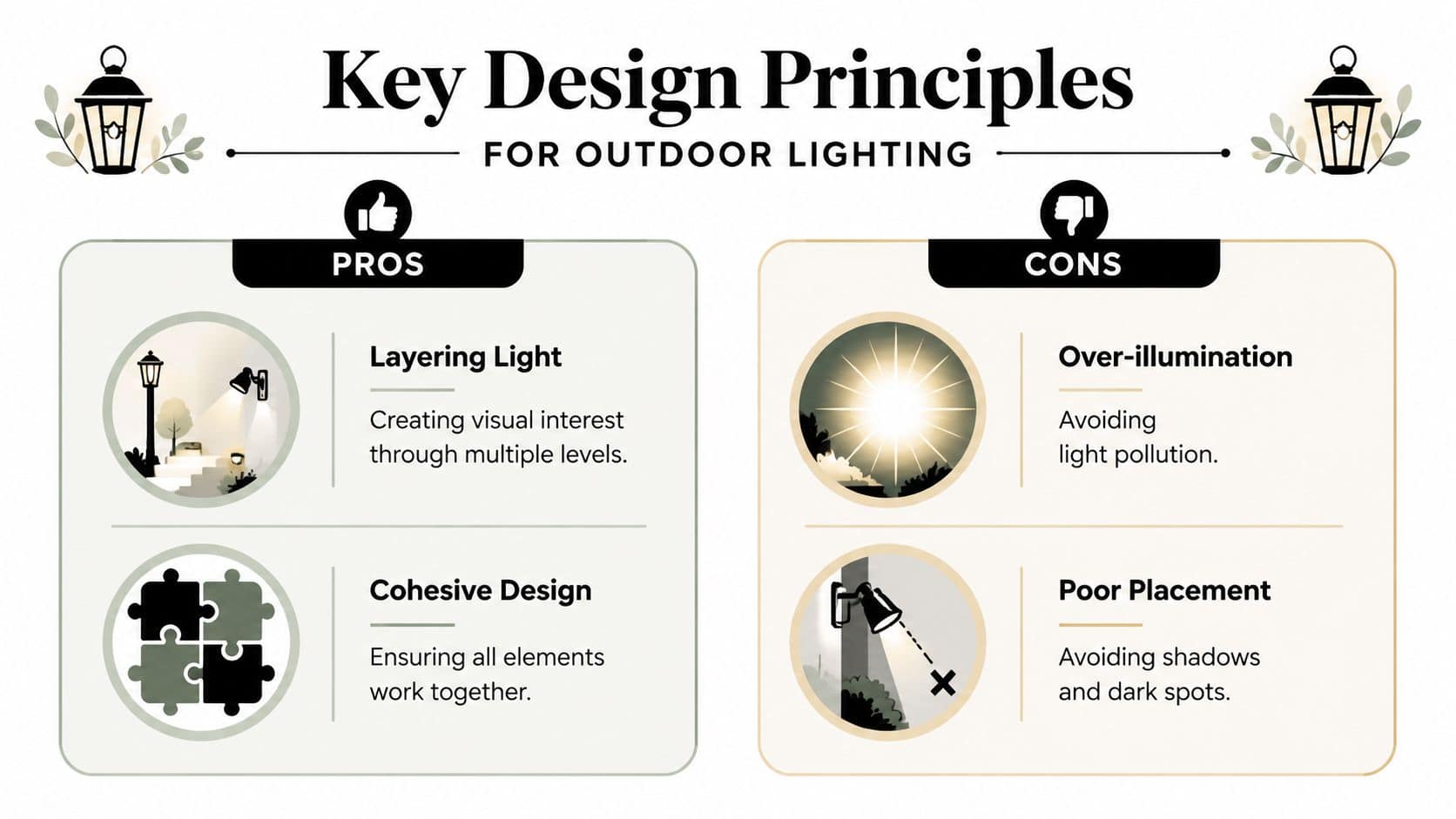
The strongest designs layer several effects. A front walk may need low guidance. The façade may need selective architectural emphasis. A tree canopy may add height, and a stone wall may need a soft graze to bring out texture. If all of that comes from one bright source, the result looks flat and a little harsh.
Placement changes everything
Fixture choice matters, but placement usually separates a polished result from an average one. For tree uplighting, a narrow 15-degree beam requires 1.5 times more distance from the trunk than a wide 60-degree beam to produce the same even wash. Path lights should be staggered 6-8 feet apart to avoid a runway effect, according to this landscape lighting placement guide.
That kind of adjustment sounds minor until you see the difference in person. One fixture moved a short distance can reduce glare, eliminate a hot spot on bark or stone, and spread light more naturally through foliage or across paving.
The eye needs focal points and restraint
A good lighting plan tells your eye where to go. On one property, the focal point may be the entry sequence. On another, it may be a pool, a mature tree, or a retaining wall that deserves more nighttime presence.
Too many focal points cancel each other out. If every bed, column, and corner is lit with equal intensity, the yard loses hierarchy. That's when outdoor lighting starts to feel busy instead of composed.
- Primary focus might be the front entry, a specimen tree, or a central patio view.
- Secondary support can come from path lights, wall washes, and gentle planting accents.
- Background presence should stay subtle so the scene has depth.
The goal isn't maximum brightness. It's controlled contrast.
Glare control is part of the design
Homeowners usually know glare when they see it, even if they don't use that word. It's the light source shining into your eyes from a seat on the patio, from inside the house, or from the driveway approach.
Nighttime aiming is essential for this reason. After installation, fixtures often require adjustment once the sun has set and the entire composition can be viewed properly. The project begins to feel complete at this stage.
The Professional Outdoor Lighting Installation Process
The installation process should feel organized, not mysterious. Most homeowners want to know where fixtures go, how wires are routed, what gets disturbed, and how the system gets dialed in after dark.
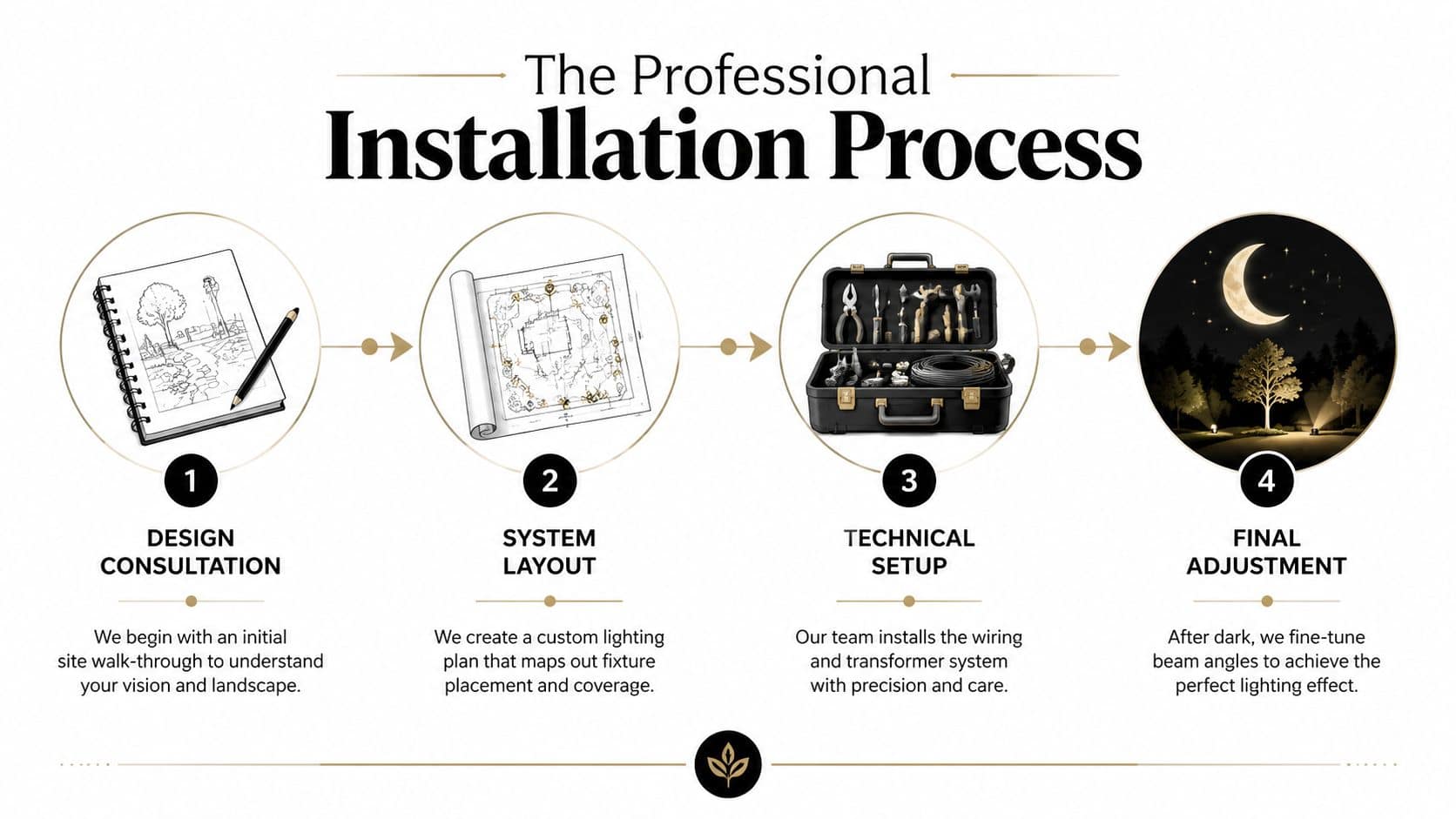
Design and layout come first
We start with the property itself. That means architecture, grades, mature plant material, steps, gathering spaces, and views from inside the home. Lighting looks different when you're standing in the yard than it does when you're looking out from the kitchen, great room, or primary suite.
When lighting is planned at the same time as a patio, pool, or retaining wall, we can place conduit, hide wire paths, and build fixture locations into the structure before surfaces are finished. That's usually cleaner than coming back later and trying to work around completed masonry or planted beds.
Wiring and transformer planning are not small details
Most residential systems use low-voltage lighting, but low voltage still needs careful planning. For every 100 feet of standard cable carrying a 100W load, voltage can drop by 10-15%, which can dim fixtures and shorten LED life, according to this outdoor lighting installation guidance from Alliance Outdoor Lighting.
Professionals deal with that by selecting the proper wire gauge, balancing fixtures across separate runs, and checking voltage at the furthest fixture so it stays above 11V on a 12V system. That work doesn't show from the patio, but it affects how evenly the system performs.
Installation day is careful, not dramatic
A clean installation usually involves light trenching, protected cable routing, secure connections, transformer placement, and fixture setting. The best work is often the least visible. You shouldn't end up with obvious wire paths, awkward fixture stems, or hardware scattered where it doesn't belong.
The final pass happens after dark. Beam angles get adjusted. Shielding gets fine-tuned. A tree that looked right on paper may want a different aim in real conditions. A step light may need less output than expected once the full system is on.
- Daytime walk-through identifies route lines, obstacles, and final fixture locations.
- Technical setup covers wire sizing, load balancing, and protected connections.
- Night aiming resolves glare, uneven spread, and missed focal points.
If the system is only checked in daylight, it isn't really finished.
Integrating Lighting with Landscape and Hardscape Projects
Lighting works best when it's planned with the rest of the project. A new patio, pool surround, seating wall, front entry walk, or outdoor kitchen gives us the chance to place lighting where it belongs instead of forcing it in after the fact.
A seat wall can be detailed with lighting under the cap. Steps can receive built-in illumination before the masonry is complete. Conduit can run beneath patios before pavers are laid. Those decisions make the finished space look intentional because the light source is tied to the architecture rather than added around it.
Why integrated planning usually looks better
When lighting is treated as a later add-on, the compromises show up quickly. Wires have fewer hiding places. Fixture locations are dictated by what's easiest to reach rather than what looks right. Some areas end up overlit because there wasn't a good way to place a fixture where it should have gone.
Planning lighting during the design phase also gives us a better way to coordinate circulation, seating, plantings, and structures. A pergola, pavilion, fire feature, or pool terrace doesn't need one lighting idea. It needs several working together.
If you're planning a larger build, our patio and deck design-build services are often where that coordination starts. Lighting is one layer in the overall composition, along with grades, materials, drainage, and how the space gets used.
LEDs and controls fit naturally into integrated design
Modern low-voltage LED systems make this easier because they're compact, efficient, and flexible enough for multiple lighting zones. Controls can support different moods for circulation, entertaining, or quiet evenings outside without changing the physical layout of the project.
For homeowners collecting ideas before a consultation, the Golden Lighting landscape design guide is a useful visual reference for thinking about paths, trees, entries, and outdoor gathering areas in layers rather than as isolated fixtures.
Smart Controls Energy Use and Long-Term Performance
A lighting system usually gets judged years after installation, not the night it turns on. What matters then is whether it still reads well, runs predictably, and holds up without constant adjustment or replacement.
LED technology has changed that conversation for the better. The U.S. Department of Energy notes that LED products use much less energy than incandescent lighting and can last far longer in service, which is one reason we now spend more design time on beam control, dimming, and fixture construction than on bulb replacement planning. For homeowners, that shifts the long-term value question from simple wattage to how the system is controlled and how well the hardware survives outside conditions. The Department of Energy's overview of LED lighting gives a good baseline on those performance differences.
Controls should match the way the property is actually used
I do not like a one-schedule system for every part of a property. The front walk, dining terrace, steps, and architectural accents usually need different operating logic if the goal is comfort rather than just visibility.
A good control plan often includes:
- Photocells so the system responds to seasonal daylight changes
- Timers or astronomical schedules for predictable operation without constant manual changes
- Zoning so arrival areas, entertaining spaces, and secondary paths do not all run the same way
- Dimming to reduce glare and let spaces feel calmer on ordinary nights
Those choices affect performance as much as convenience. If every fixture runs at full output every evening, the space can feel flat, bright, and less inviting than it should.
Long-term durability starts with fixture quality and system setup
Outdoor fixtures deal with moisture, irrigation spray, dirt, temperature swings, and ground movement. In Pennsylvania, freeze-thaw cycles add another layer of stress, especially where soil shifts or surface materials move slightly through the seasons.
That is why I pay close attention to housing material, gasket quality, connection points, and whether a fixture is likely to stay aimed after a winter or two. Solid brass usually ages better than lighter, less durable housings. Better components cost more upfront, but they tend to reduce callbacks, misalignment, corrosion, and early failure.
The control strategy matters here too. Lower output, shorter run times, and properly separated zones can reduce wear on the system over time.
One practical point. Kennedy Outdoor Living handles lighting as part of a broader design-build process, which helps when the control plan, fixture locations, and structural elements need to work together instead of being decided separately.
Budgeting for Professional Outdoor Lighting
Most homeowners ask about cost early, and that's reasonable. The honest answer is that the budget depends on scope, materials, site conditions, and how thoroughly the lighting is integrated into the project.
A front entry lighting plan is different from a full-property system with path lights, tree accents, built-in hardscape lighting, and multiple control zones. Rocky soil, long wire runs, finished surfaces, and mature root zones can also change the labor involved.
What usually drives the budget
A professional proposal is usually shaped by a few practical factors:
- Overall scope includes how many areas need lighting and how many fixture types the design calls for.
- Fixture quality affects appearance, durability, and how well the system holds up over time.
- Installation complexity includes access, trenching conditions, finished hardscape, and how discreetly wiring can be routed.
- Control options range from simple scheduling to more customized zoning and dimming.
The cheapest quote often leaves out the parts that make the system feel finished. That can mean weaker fixture materials, limited design time, less careful aiming, or a wiring plan that works on day one but doesn't perform evenly across the property.
The better budgeting question
Instead of asking only what the system costs, ask what the proposal includes. Does it account for nighttime adjustment. Is the transformer sized with room for expansion. Are fixture locations driven by design intent or just by convenience. Those details usually tell you more than the number alone.
For permitting or code questions related to a specific property in Pennsylvania, it's always smart to confirm requirements with your local building department because rules can vary by municipality and project scope.
Frequently Asked Questions About Outdoor Lighting
Can outdoor lighting be added to an existing patio or landscape
Yes, but it's usually easier and cleaner when it's planned during the original design and build. Existing projects can still be lit well, though the routing of wire and fixture placement may involve more compromises than an integrated plan.
How long does an outdoor lighting installation take
That depends on the size of the property, the number of fixtures, site access, and whether lighting is part of a larger build. Smaller systems move faster, while integrated projects tied to masonry, pools, or major landscaping take more coordination.
Will the lights be too bright at night
They shouldn't be. A good design uses layering, shielding, aiming, and restraint so you can see paths, steps, and focal points without glare or a washed-out yard.
Is low-voltage lighting strong enough for a larger property
Yes, if the system is designed correctly. Wire sizing, load balancing, transformer selection, and fixture placement all matter, especially on longer runs or larger properties.
Can the system be expanded later
Often, yes. Expansion is easier when the original design leaves room in the transformer and considers future zones, such as a pool area, new garden bed, or added seating space.
Is professional installation really worth it over a store-bought kit
For most permanent projects, yes. Store kits can work for temporary or very small applications, but they rarely deliver the same fixture quality, wiring reliability, glare control, or integrated design you get from a professionally planned system.
Start Your Outdoor Lighting Design Conversation
If you're thinking about outdoor lighting installation for a patio, pool, front entry, or full backyard project, the right first step is a design conversation. You can contact us through our Kennedy Design+Build contact page or call (610) 854-9993 in Center Valley to talk through your project.
If you're planning a custom outdoor space and want lighting treated as part of the design, not an afterthought, talk with Kennedy Outdoor Living. We serve homeowners across the Lehigh Valley from Center Valley, PA 18036, and we're happy to start with a straightforward consultation.