Dry Well vs French Drain: Which Is Right for Your Yard?
Quick Answer
For most homeowners comparing dry well vs french drain, the right choice comes down to how water behaves on the property. A French drain moves water away from wet areas, while a dry well collects and disperses water into the soil. In Lehigh Valley clay soils, French drains usually handle heavier, continuous water better, while dry wells work well for targeted runoff in better-draining soils.
If you're planning a patio, pool, outdoor kitchen, or a full backyard renovation, drainage isn't a side issue. It's one of the first design decisions that determines whether the finished space stays usable, stable, and attractive after heavy rain.
A lot of clients come to us with the same problem. They want to build something beautiful, but they already know water is part of the story. Maybe the lawn stays wet near the house, maybe a downspout dumps water beside a future patio, or maybe an existing entertaining area turns soft and muddy every spring. That’s where the dry well vs french drain decision matters. It affects grading, base preparation, material longevity, and how the whole outdoor space functions together. If you're thinking through a larger outdoor project, it's worth looking at how drainage fits into the full design-build services involved in an outdoor living project.
How Each Drainage System Works
A French drain and a dry well solve different site conditions, and we design them differently from the start. One carries water away from a problem area. The other stores collected runoff below grade and lets the soil absorb it over time.
| System | Basic function | Best fit | Limitation |
|---|---|---|---|
| French drain | Collects and redirects water away from an area | Persistent wet zones, foundation edges, slope runoff, clay-heavy soils | Needs a discharge strategy and proper installation |
| Dry well | Collects water in one location and lets it soak into surrounding soil | Downspouts, patio runoff, point-source drainage in well-draining soils | Performance depends heavily on soil permeability |
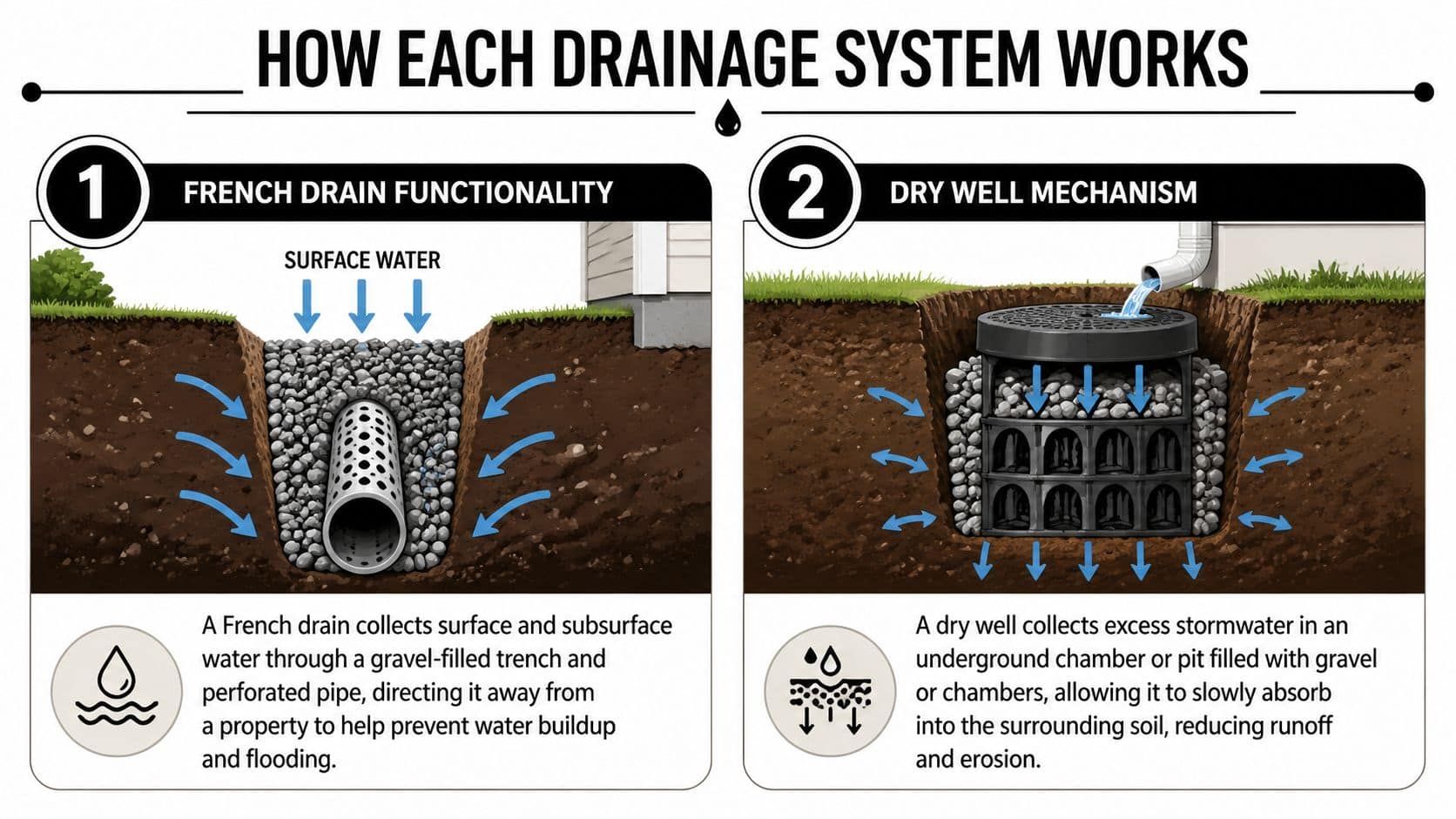
How a French drain handles water
A French drain is a gravel-filled trench with perforated pipe set below grade. It intercepts water as it moves through the soil or across the surface, then routes that water toward a planned outlet.
The pipe is only part of the system. The trench depth, slope, gravel size, filter fabric, and discharge point all affect whether it performs for years or becomes an expensive buried failure. In our work, the primary design question is not whether a French drain can collect water. It is where that water will go after collection, and how that route fits around patios, planting beds, lawn areas, and the structure itself.
French drains are the right tool when the wet area has length. A side yard that stays soft after rain, water tracking along a foundation, or runoff pushing across the edge of a terrace are common examples.
Practical rule: If the problem shows up as a wet line, a wet edge, or a repeating band of saturation, start by evaluating a French drain.
How a dry well manages runoff
A dry well is an underground chamber or stone-filled pit that receives water from a single collection point and releases it into the surrounding soil. It does not transport water across the site. It gives captured runoff a place to infiltrate below the surface.
That difference matters in design. A dry well works best when runoff is concentrated and predictable, such as at a downspout, an area drain in a small patio, or a discrete low spot tied to a drain inlet. It can be hidden under lawn or planting space, which helps preserve clean sightlines in a finished backyard, but concealment does not make it forgiving. If the surrounding soil is dense clay or already seasonally saturated, the chamber can fill faster than the soil can absorb water.
In other words, a dry well depends on infiltration. A French drain depends on conveyance.
Why the distinction matters in real design
This choice affects more than drainage performance. It affects how we grade the yard, how much excavation is required, where we can place trees and hardscape, and whether the finished space stays usable after a storm.
On a high-end project, drainage should disappear visually but stay fully accounted for in the plan. A dry well can protect the clean lines of a patio or entry court by keeping outlets and swales out of view. A French drain can protect the base of a retaining wall, pool deck, or foundation planting zone by relieving water pressure before it starts causing movement or staining.
The right system follows the water pattern on the property. If the site needs water moved, we design for movement. If the site can absorb runoff in one controlled location, we design for infiltration. In many yards, the best answer is a combination of both, each placed where it supports the layout instead of fighting it.
Comparing French Drains and Dry Wells for Your Property
A drainage plan has to fit the property you have and the outdoor space you want to build. On one lot, I may route water away from a slope and patio with a French drain. On the next, I may collect roof runoff in a dry well so the lawn, planting beds, and entertaining areas stay visually clean.
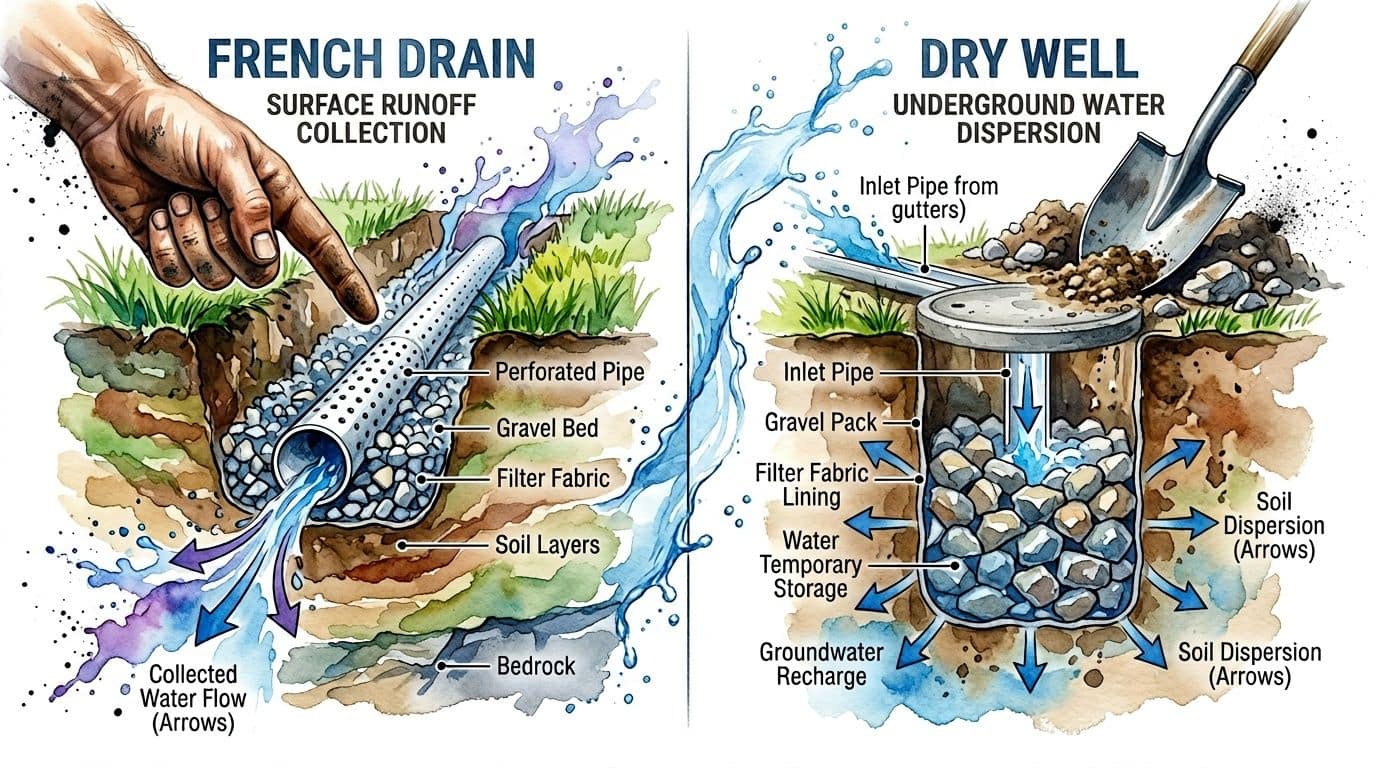
Soil conditions in the Lehigh Valley
In much of the Lehigh Valley, soil is the deciding factor.
Heavy clay holds water and drains slowly. On those sites, a dry well can become a storage tank that empties too slowly after a storm, especially if runoff from roofs or paved areas keeps feeding it. A French drain usually gives us more control there because we can intercept water and send it toward a suitable outlet instead of waiting for tight soil to absorb it.
Sandy and loamy soils open up more options. In those conditions, a dry well can work well for downspouts, small patio drains, or a contained low area where water can infiltrate without affecting nearby hardscape.
Water volume and water pattern
I look at two questions first. Is the water spread out or concentrated? Is it occasional, or does the area stay wet for long stretches?
French drains are better for recurring linear problems. That includes seepage along a foundation edge, water collecting at the base of a retaining wall, or runoff tracking across a grade break and into a patio zone. Dry wells fit point-source collection. They make sense when water arrives at one inlet, then has time and soil conditions that allow it to soak in below grade.
A downspout at one corner of the house and a broad soggy side yard call for different design responses.
Installation impact on the site
The construction footprint matters, especially on finished properties. A French drain needs a continuous trench, so we plan the route around utilities, root zones, existing lighting, irrigation lines, and any paving you want to preserve. That route also affects the final grading plan.
A dry well keeps excavation more contained. That can be a smart choice if the goal is to protect a mature garden, avoid cutting through a new lawn panel, or keep drainage infrastructure out of view near an outdoor living area.
Homeowners weighing a larger build can see that relationship in this private Macungie backyard makeover, where layout, grading, and water management had to work together from the start.
Maintenance and long-term ownership
Installation is only one part of the decision. Ownership is the other.
French drains can collect sediment over time, and that risk goes up if the pipe is undersized, the gravel envelope is poorly detailed, or runoff carries a lot of fines from bare soil or mulch beds. Dry wells often stay quieter from a maintenance standpoint, but only when they are placed in soil that can absorb water at a reasonable rate and when pretreatment keeps debris out of the chamber.
For a client investing in a premium patio, pool surround, or outdoor kitchen, I am not choosing the system that only solves the puddle you see today. I am choosing the one that protects base preparation, planting health, finish materials, and day-to-day use of the space over time.
Design consequences you can see
Drainage decisions show up in the finished yard. A poorly placed French drain outlet can create a damp edge beside a lawn panel or entertaining space. A dry well installed too close to hardscape can keep soil wet where paver bases, seat walls, or planting pockets need stability.
For that reason, drainage should be designed with the project, not added after construction. If it is treated as an afterthought, the result often shows up in settled pavers, softened turf edges, stained masonry, and planting beds that never quite dry out.
Integrating Drainage into Your Landscape Design
Good drainage design should protect the investment without announcing itself. In high-end outdoor work, the goal isn't just to remove water. It's to do it in a way that keeps the space clean, comfortable, and visually quiet.
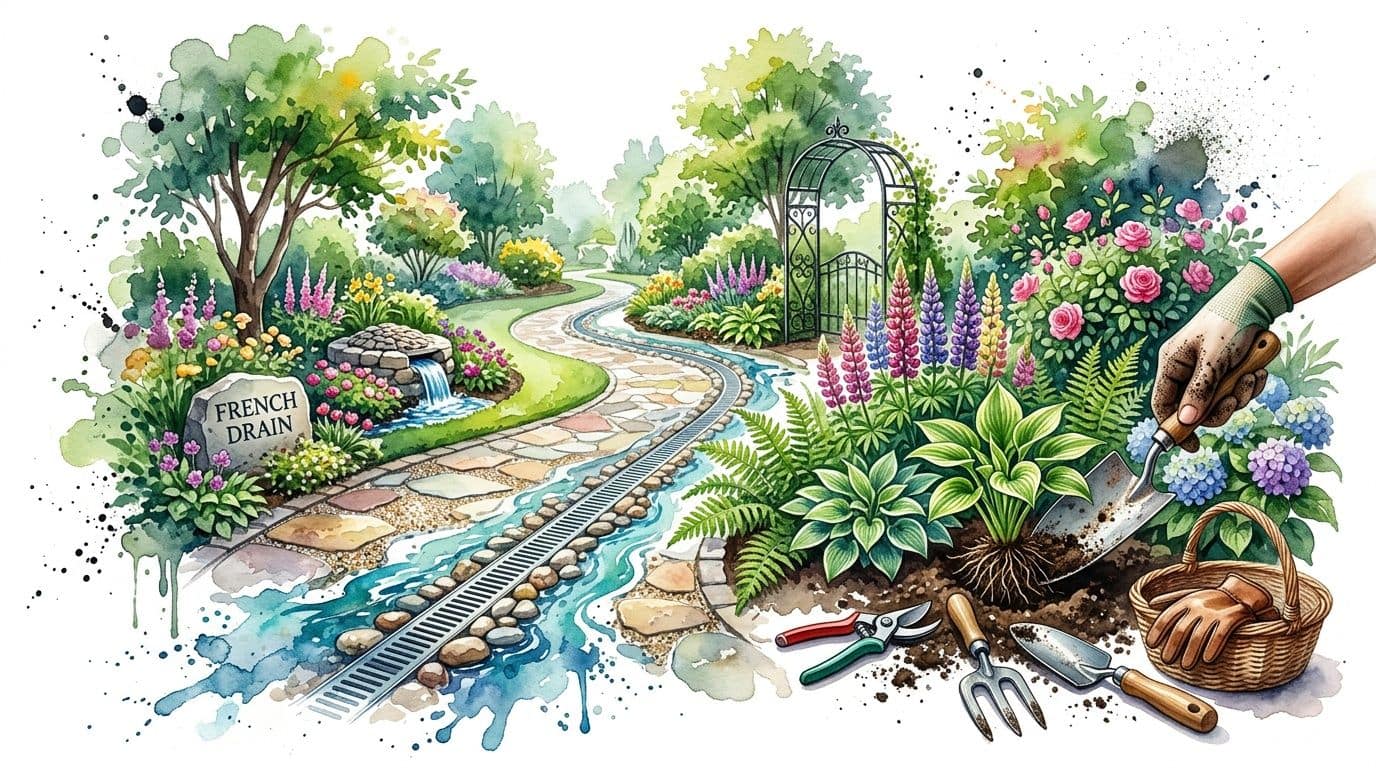
Where drainage meets design
The drainage system directly affects outdoor layout. A French drain's discharge point has to be planned carefully so it doesn't create a muddy area during gatherings, while a modern dry well can be hidden beneath a permeable patio or built into the outdoor area as an intentional feature, as explained in this discussion of drainage and outdoor design integration.
That’s a design issue, not just an engineering one. If you're laying out a dining terrace, pool surround, fire feature, or outdoor kitchen, drainage affects where those elements should go and how they need to be built.
What we account for before construction starts
When drainage is integrated early, several decisions get better:
- Patio base protection: A drainage plan helps keep water from weakening the sub-base beneath pavers or stone.
- Door and threshold transitions: Finished elevations need to move water away from the house without making steps, landings, or access awkward.
- Plant bed performance: Water that sits too long around roots can create recurring problems in beds adjacent to hardscape.
- Guest circulation: Walkways, seating zones, and transitions around outdoor kitchens or pools should stay usable after rain.
These aren't separate problems. They're one design problem with several consequences.
A beautiful patio that stays wet at the edges isn't finished well, even if the stonework itself looks excellent on day one.
Dry well vs french drain in entertaining spaces
If the property needs a clean visual finish, a dry well often has an advantage because the system can remain largely invisible. That matters when the client wants uninterrupted paving, simple planting, and no obvious exit point for water.
A French drain often earns its place when the drainage demand is broader and more persistent. In those cases, the design work shifts to concealment, outlet strategy, and grading so the utility doesn't become visible in the wrong place.
This is especially important around custom hardscape work. If you're planning a larger backyard layout, drainage should be considered as part of the overall patio and deck design process, not after materials are selected.
Choosing features that support the drainage plan
Some yards benefit from combining visible and hidden elements. Surface inlets, collection points, gravel bands, planting transitions, and permeable areas can all support the main drainage strategy without making the yard feel overbuilt.
For homeowners comparing approaches, this guide on strategies to prevent soggy lawns is a useful supplemental resource because it frames drainage as part of the broader yard layout rather than a single fix.
Why cost and approvals vary with the design
The final cost depends on what the site asks for. A straight run with open access is different from working around mature landscaping, existing utilities, finished hardscape, retaining walls, or tight side-yard access.
Material choices matter too. Pipe layout, gravel volumes, chamber style, surface drains, restoration work, and integration with surrounding construction all affect scope.
Permitting is similar. Requirements vary by municipality and by project type in Pennsylvania, so it's smart to verify what applies with the local building department before work starts. On larger outdoor projects, drainage often intersects with grading, hardscape, and structure placement, which is another reason to solve it during design rather than in the field.
Cost Factors and Permitting in Pennsylvania
Homeowners always want the same answer first. Which costs less. The honest answer is that the better value depends on the site and on how much work the drainage system is protecting.
A source focused on lifecycle comparison notes that dry wells generally have a lower upfront installation cost, averaging around $3,000, while French drains average $6,000, and that French drains may also need periodic cleaning over time, which affects ownership cost and project ROI, according to this cost comparison for French drains and dry wells.
Choose this if your site fits these conditions
- Choose a dry well if runoff is concentrated at one location, the soil drains well, and the project calls for a low-visibility solution.
- Choose a French drain if the property has persistent wet areas, clay-heavy soil, or water moving across a larger stretch of yard.
- Choose a combined approach if water shows up in more than one pattern and the outdoor project includes multiple structures or grade changes.
What actually drives the price
The main cost drivers are labor, excavation complexity, site access, soil conditions, restoration, and how much of the yard or hardscape has to be protected during installation. French drains often become more involved when trench routes are long or discharge planning is difficult. Dry wells become more involved when excavation is deep, access is tight, or multiple collection points feed the system.
If you want a broader homeowner-oriented overview of French drain installation cost, that resource is useful for understanding why simple online estimates often miss the actual variables.
Permitting and local review
Permit requirements are not uniform across Pennsylvania. Municipal rules can vary, even between nearby communities. If drainage work is tied to larger hardscape, pool, retaining wall, or grading improvements, it's worth confirming local requirements early.
The practical move is to review the site first, then verify municipal requirements before finalizing construction scope. If you want to talk through a specific property, the easiest next step is a project inquiry through the contact page.
Common Questions About Yard Drainage Solutions
How do I know if I actually need drainage work?
If water pools after rain, the lawn stays soft long after surrounding areas dry, or runoff repeatedly moves toward the house, patio, or pool area, you likely have a drainage issue worth evaluating. The key isn't whether you see water once. It's whether the same pattern keeps returning and affects how the space functions.
Can a dry well be installed under a patio?
Yes, in the right conditions, a dry well can be located beneath or near a patio area as part of the overall drainage design. The important part is matching the system to soil conditions and making sure the hardscape base, elevations, and runoff collection points are designed together.
Is a French drain better for foundation protection?
Often, yes, when water is collecting or traveling along the foundation line. A French drain is built to intercept and redirect water away from that kind of linear problem, which is different from handling a single concentrated discharge point like a downspout.
Can both systems be used on the same property?
Yes. Some sites need one system to move water and another to disperse it. That can make sense on larger or more complex properties where roof runoff, slope runoff, and foundation moisture are all happening in different parts of the yard.
The right answer is sometimes "both," but only when each part of the system has a clear job.
Will installation tear up my whole yard?
Not necessarily, but every drainage project creates some disruption because excavation is involved. The amount depends on access, route length, existing hardscape, and whether the system is being installed before or after a larger outdoor construction project.
Is this a good DIY project?
Usually not if the issue affects structures, finished hardscape, or long-term site grading. Drainage failures often come from errors in slope, outlet planning, soil assumptions, or tying one element into another without understanding the whole water path.
How long does drainage installation take?
Timing depends on site conditions and scope, so it shouldn't be promised without seeing the property. A focused point-source solution is different from a routed drainage system tied into a larger build, and weather can change the sequence as well.
What if my water problem is inside the basement, not just outside?
Exterior drainage may still be part of the answer, but basement water issues can also involve interior waterproofing or pump systems. If the concern includes water entering the home, it can help to review sump pump solutions for homes alongside site drainage so you're looking at the problem from both the exterior and house side.
Will drainage infrastructure be visible when the project is done?
It doesn't have to be. Some systems are easy to hide, and others can be blended into planting, grading, or surface collection details so they don't distract from the design. That planning should happen before layout and material decisions are finalized.
Where can I read more before scheduling a consultation?
If you want to keep researching, it helps to read project-focused information rather than generic lists of drainage products. A good starting point is the Kennedy Design + Build blog, especially if you're comparing drainage decisions alongside patios, pools, and other outdoor living work.
Start Your Custom Drainage and Landscape Plan
The right dry well vs french drain choice protects more than your lawn. It protects patios, plantings, foundations, circulation, and the day-to-day usability of your outdoor space. On a well-designed property, drainage should support the experience unobtrusively and reliably.
If you're planning a project in Center Valley, Allentown, Coopersburg, or elsewhere in the Lehigh Valley, it helps to make the drainage plan part of the design from the start.
If you're ready to talk through drainage as part of a larger outdoor project, Kennedy Outdoor Living can help you evaluate the site, align the drainage plan with the design, and build a solution that fits your property. Call (610) 854-9993, visit Center Valley, PA 18036, or start the conversation at kennedydb.com.